Lost Pension Pots 2026: How To Find And Claim What Is Yours
[…]

Broker reviews
Choose a UK investing platform
 eToro
eToro Plus500
 Interactive Brokers
 J.P. Morgan
 Vanguard UK
 Trading 212
 AJ Bell
 Trading.com
 Lightyear
 Webull UK
 XTB UK
 Robinhood UK
 Hargreaves Lansdown
 Interactive Investor
 InvestEngine
Every review covers fees, account types, safety and FCA regulation, and is updated as providers change their pricing.
Both charge 0% commission on real shares and ETFs, so the difference that decides it is currency costs, what each ISA is allowed to hold, and whose balance sheet your ISA actually sits on.

By David Katzarov, Editor
Published: | Fact-checked by: Dimitar Kanazirski | Last updated:
0% ISA commission | Bonds and funds | Cash ISA
Capital at risk.
0% commission | Flexible ISA | Up to 4% on cash
Capital at risk.
0% ISA commission | Bonds and funds | Cash ISA
0% commission | Flexible ISA | Up to 4% on cash
eToro is a global multi asset platform, authorised in the UK as eToro (UK) Ltd, FRN 583263, from One Canada Square in Canary Wharf. For long term UK investors the news that matters arrived on 29 July 2026, when eToro removed dealing commission and the annual custody fee from its stocks and shares ISA. That ISA is administered by Moneyfarm rather than by eToro itself, on both the DIY and the managed route, which is a real structural difference we return to under safety and regulation. Our full eToro review covers the platform in depth.
eToro also offers CFDs and crypto. CFDs are leveraged products and sit outside the scope of this comparison, which covers real investing and ISAs only. eToro’s own disclosure is that 51% of retail investor accounts lose money trading CFDs with them.
XTB is a long established broker, authorised in the UK as XTB Limited, FRN 522157, also at One Canada Square in Canary Wharf. It says it has more than 2.5 million investors and over twenty years in the market. Its UK proposition is narrower than eToro’s, deliberately so: a flexible stocks and shares ISA with no platform or custody charge, 0% commission on real shares and ETFs, and up to 4% AER on sterling you have not yet invested. Boring Money named it Best for low cost ISA in 2025. Our full XTB review has the detail.
XTB also offers CFDs. Again, leveraged products are outside the scope of this page. XTB’s own published figure is that 74% of retail investor accounts lose money trading CFDs with them.
| Criteria | eToro |
XTB |
|---|---|---|
| Overall rating | ★★★★★★★★★★4.3 / 5 | ★★★★★★★★★★4.4 / 5 |
| Best for | A conventional multi asset ISA | Low cost share and ETF investing |
| Regulator | FCA (eToro (UK) Ltd, FRN 583263) | FCA (XTB Limited, FRN 522157) |
| ISA platform or custody fee | £0 | £0 below EUR 250,000 |
| Dealing commission, shares and ETFs | £0 | £0 to EUR 100,000 monthly turnover |
| Commission above the threshold | Not applicable | 0.2%, minimum £10 |
| Currency conversion fee | 0.70% | 0.5% |
| Interest on uninvested cash | Not published for the ISA | Up to 4% AER variable |
| ISA administered by | Moneyfarm (MFM Investment Ltd) | XTB Limited itself |
| Account types | Stocks and Shares ISA (DIY and Managed), Cash ISA, general investing | Stocks and Shares ISA, Cash ISA, general investing |
| Investment choice in the ISA | Over 1,000 shares, ETFs, bonds and mutual funds | Over 6,900 real stocks and 2,200+ ETFs |
| Bonds and mutual funds | Yes | No |
| Fractional shares | Yes | Yes, from £1 |
| Recurring investing | Recurring Investments | ETF investment plans |
| Flexible ISA | Not stated on the ISA pages | Yes |
| ISA transfers in | Yes, assets sold and moved as cash | Yes, up to 30 days, app only |
| Junior ISA and Lifetime ISA | No | No |
| SIPP | No | No |
| Inactivity fee | None for UK clients | None on the ISA |
| Withdrawal fee | None on GBP accounts | None published on the ISA |
| FSCS protection | £85,000 via MFM Investment Ltd | £85,000 investments, £120,000 cash deposits |
Fees and product details checked August 2026. XTB quotes different totals in different places on its own site; we use its latest figure of over 6,900 real stocks and 2,200+ ETFs across 16 markets. Always confirm current terms on the provider’s own site.
eToro
eToro charges 0% commission on real shares and ETFs. Inside the stocks and shares ISA, since 29 July 2026, there is no dealing commission and no annual custody fee. eToro’s own ISA pricing shows zero on UK and US shares, ETFs and mutual funds, zero on bonds and European shares, and zero custody. There is no platform fee on top and no minimum monthly charge, so on the commission line eToro is now as cheap as this market gets.
XTB
XTB charges 0% commission on real shares and ETFs up to the equivalent of EUR 100,000 of monthly turnover. Above that it is 0.2%, with a minimum of £10. The ISA carries no platform or custody charge below the equivalent of EUR 250,000. For someone contributing a few hundred pounds a month to a handful of holdings, neither threshold is reachable, so the practical rate is zero. For anyone trading in and out weekly, the 0.2% and the £10 floor start to matter.
eToro
eToro charges 0.70% on assets priced in a currency other than sterling. Because almost every US listed share and a great many ETFs are priced in dollars, this is the fee most investors will genuinely pay. On a £10,000 purchase of US shares that is £70, and you pay it again on the way out. Buy and sell that position once and the round trip costs roughly £140 in currency conversion, on an account advertising 0% commission.
XTB
XTB charges 0.5%. The same £10,000 US share purchase costs £50, and about £100 on the round trip, so roughly £40 less than eToro each time. The gap compounds with every contribution if you are drip feeding money into overseas holdings each month. Neither is cheap by the standards of the lowest cost UK platforms, but between these two XTB is consistently the cheaper account to run. For a lower conversion charge still, our Trading 212 vs XTB comparison sets XTB against Trading 212’s 0.15%.
eToro
eToro does not publish a cash interest rate for the ISA on its ISA pages, so treat uninvested money there as earning nothing until eToro says otherwise. On the other side of the ledger there is no inactivity fee: eToro states plainly that the inactivity fee does not apply to clients of eToro (UK) Ltd resident in the UK. Withdrawals from a GBP account are free with no minimum. The $5 charge and the $30 minimum apply only to USD investment accounts, not to a sterling account.
XTB
XTB pays up to 4% AER on uninvested sterling, variable, from 1 May 2026, calculated daily and paid monthly. If you contribute monthly and invest in batches, or hold cash while you decide, that is a real return on money that would otherwise sit idle. There is no inactivity fee on the ISA either. Between the lower conversion charge and the interest on cash, XTB is the cheaper account to hold as well as to trade in.
eToro
eToro offers a stocks and shares ISA, a Cash ISA and a general investing account. The stocks and shares ISA comes in two forms: a DIY route where you choose your own holdings from over 1,000 shares, ETFs, bonds and mutual funds, and a Managed route where a portfolio is built and rebalanced for you against a risk profile. Both routes are administered by Moneyfarm and the managed one is priced separately, so do not assume the DIY 0% carries across. There is no SIPP, no Junior ISA and no Lifetime ISA. eToro also offers crypto, which cannot be held in an ISA and sits outside long term investing.
XTB
XTB offers a flexible stocks and shares ISA, a Cash ISA and a general investing account. There is one stocks and shares ISA, XTB’s own, with no DIY or managed split to weigh up. It accepts transfers in from both stocks and shares ISAs and cash ISAs, normally within 30 days, though the transfer has to be started in the app. Like eToro there is no SIPP, no Junior ISA and no Lifetime ISA, so neither platform can be the only home for a whole family or a whole retirement plan.
eToro
eToro’s DIY ISA lets you build across shares, ETFs, bonds and funds, and recurring investments are supported so contributions can be automated. eToro does not publish a headline ISA minimum on its ISA pages. One thing worth knowing: your ISA balance counts towards your eToro Club tier, which is a loyalty mechanism rather than an investing benefit, and should not be a reason to put £20,000 anywhere.
XTB
XTB supports fractional shares from £1, so a small monthly contribution can still be spread across several holdings rather than sitting in cash waiting to afford a whole share. Its ETF investment plans let you set an allocation and contribute to it regularly. For someone starting with modest sums and building steadily, this is the more straightforward of the two to get moving with.
eToro
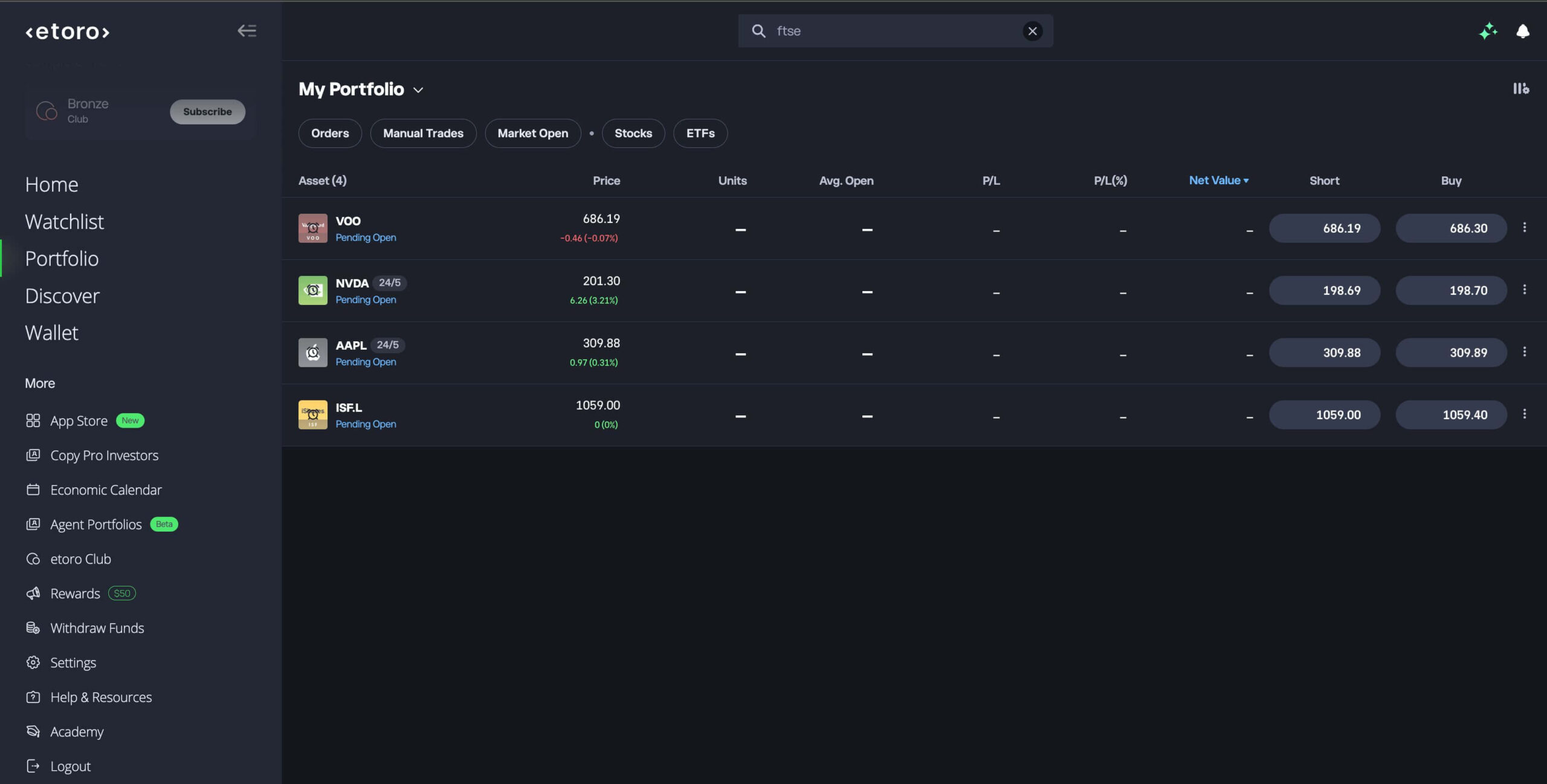
eToro’s web platform is built for a multi asset audience and it shows. Charts, watchlists, market data and a news feed sit alongside your portfolio, and the ISA is reached through the same login. If your intention is to buy three funds and leave them alone, there is a great deal of surface area you will never use, and some of it points at products, including CFDs and crypto, that have nothing to do with an ISA.
XTB
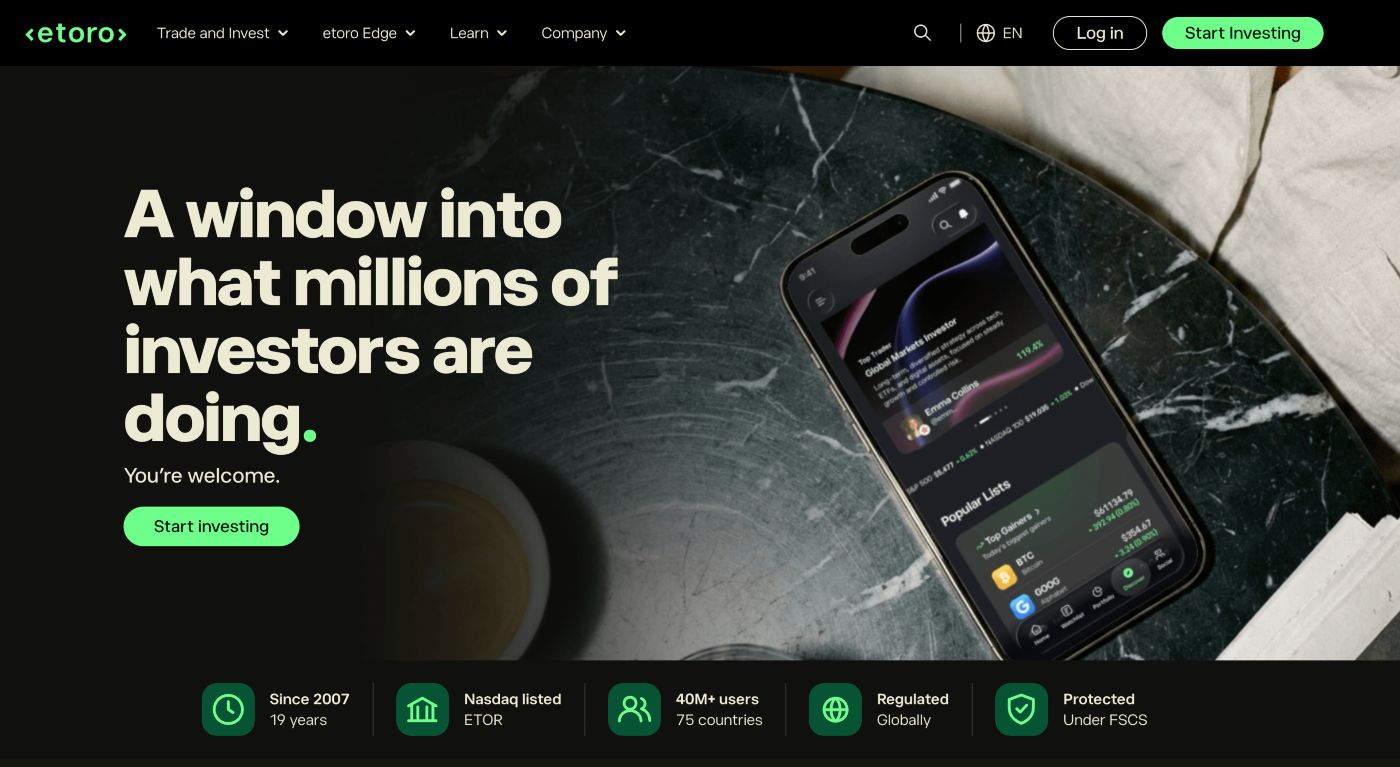
XTB’s platform is a trading terminal at heart, so it too carries more machinery than a buy and hold investor needs. The ISA section itself is comparatively contained: a defined universe of shares and ETFs, the investment plans, and your cash interest position. Neither of these is the plain, deliberately dull interface a pure index investor would design for themselves.
eToro
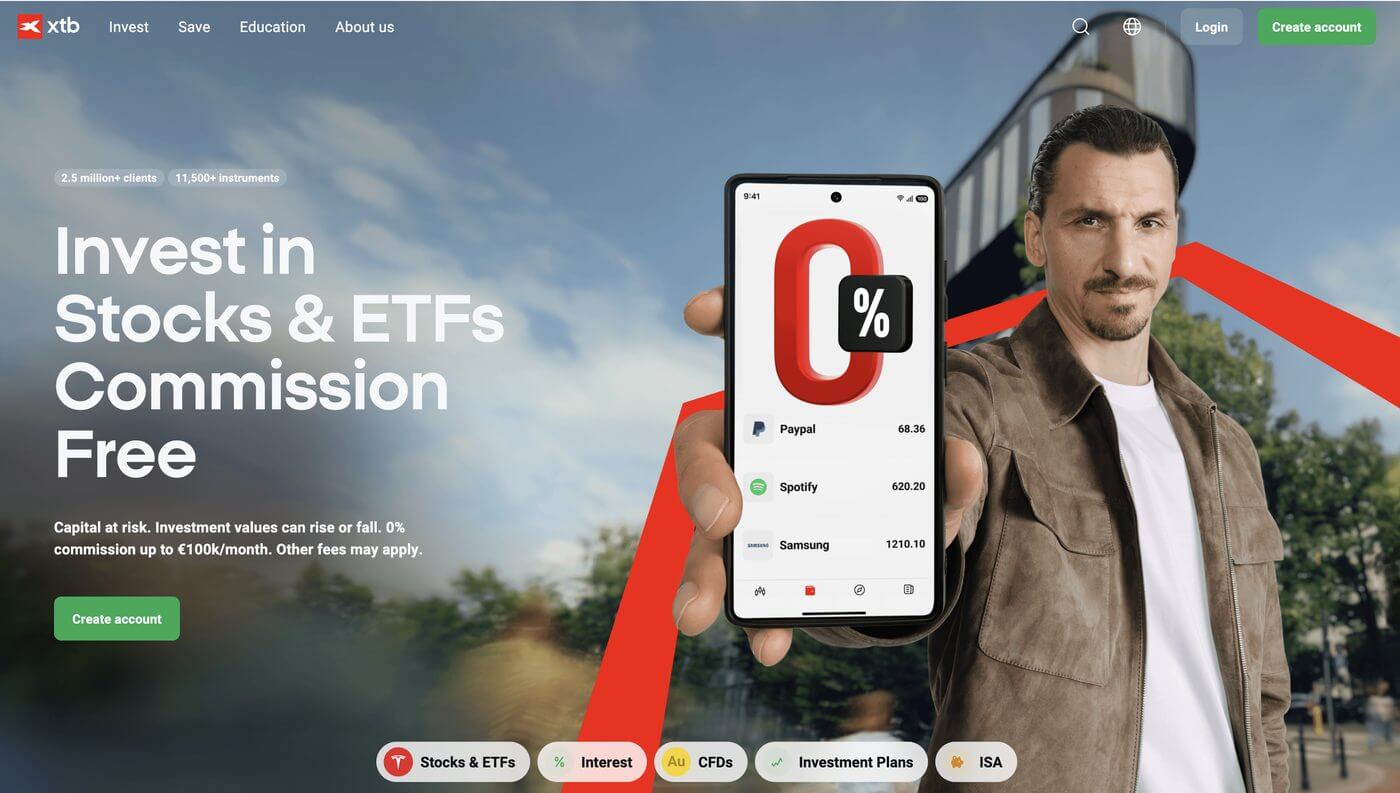
The eToro app carries the full product range and the ISA sits inside it. Search and order entry are quick and recurring investments can be managed from the phone. The same caveat applies as on the web: the app surfaces leveraged and crypto products next to your ISA holdings, which takes some discipline to ignore.
XTB
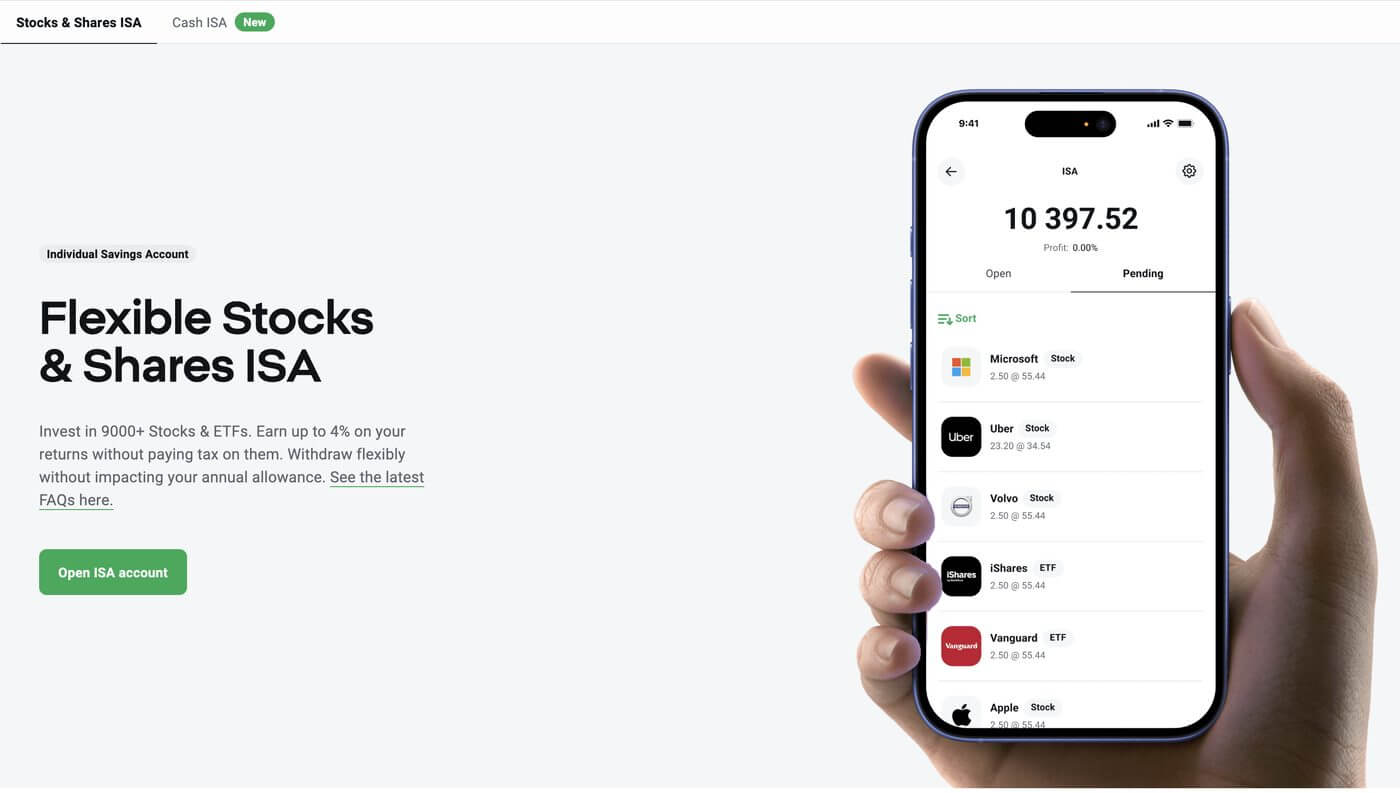
XTB’s app handles the ISA end to end, and is the only place an ISA transfer in can be started, which is a genuine limitation if you prefer doing paperwork at a desk. Day to day it covers contributions, plans, holdings and the cash interest position clearly enough.
eToro
Recurring Investments automate contributions, which is the piece that matters for a long term ISA. eToro also runs CopyTrader, which mirrors the positions of other users, and Smart Portfolios, which are thematic ready made baskets. CopyTrader is not an ISA feature and this comparison takes no view on it beyond noting that it exists.
XTB
XTB’s ETF investment plans are the closest equivalent, letting you set percentages across a basket of ETFs and contribute regularly, with rebalancing handled for you. For a long term ISA investor this is the more relevant automation of the two, because it does the one job an index investor actually wants done.
eToro
eToro’s DIY ISA gives access to over 1,000 instruments spanning UK, US and European shares, ETFs, bonds and mutual funds, on eToro’s own figure. On individual shares alone that is a shorter list than XTB’s, and it is worth being clear that this is the ISA universe rather than eToro’s full non-ISA range, which is much larger but not tax sheltered.
XTB
XTB’s latest figures list over 6,900 real stocks and 2,200+ ETFs across 16 markets. On individual shares that is a wider choice than the eToro ISA offers, and the ETF list is broad enough to build a globally diversified portfolio from a handful of holdings. What it does not include is anything outside those two categories.
eToro
eToro’s DIY ISA holds bonds and mutual funds alongside shares and ETFs. If you want a conventional multi asset portfolio, or a fixed income allocation that is not an ETF, or you simply prefer OEIC funds to exchange traded ones, eToro can accommodate you and XTB cannot. For anyone building a portfolio in that traditional shape, this decides the comparison on its own and the currency conversion difference becomes a cost of doing business.
XTB
XTB offers no bonds and no mutual funds. Its ISA is shares and ETFs and nothing else. That is a scope decision rather than a defect, and for an investor whose plan is two or three global ETFs it costs nothing at all. But it is a hard ceiling: if your plan later needs bonds or funds, you would have to move the account or run a second one elsewhere.
eToro
eToro also offers crypto and CFDs. Neither can be held in an ISA. Crypto is not covered by the Financial Services Compensation Scheme and is not part of long term investing as this site uses the term. CFDs are leveraged derivatives and are outside the scope of this page. If CFDs are what you are weighing up, our Plus500 vs eToro comparison sets eToro’s trading side against a CFD only provider.
XTB
XTB also offers CFDs, on exactly the same basis: leveraged, impossible to hold in an ISA, and outside this comparison. If your interest is strictly a tax efficient long term portfolio, both platforms’ non-ISA ranges are noise you can ignore, though you will have to ignore it actively because both put it in front of you.
eToro
This is the least obvious and most useful difference on the page. eToro (UK) Ltd is authorised and regulated by the Financial Conduct Authority, FRN 583263, at One Canada Square, Canary Wharf. But the ISA is not eToro’s own product. Both the DIY and the Managed routes are administered by Moneyfarm, and eToro’s own pages describe the account as the eToro ISA, powered by Moneyfarm.
Your ISA money and investments are held in segregated accounts with MFM Investment Ltd, Moneyfarm’s regulated entity, FCA number 629539, which in turn appoints custodians such as Barclays and Saxo Capital Markets UK Ltd. So you open the account through eToro, you see it in the eToro app, and the firm holding your assets and owing you the client money duty is a different company altogether.
This is not inherently worse. Moneyfarm is long established and separately regulated. But you should know it before committing £20,000, because it determines who you chase when something goes wrong and whose failure your compensation claim would be made against.
XTB
XTB Limited is authorised and regulated by the Financial Conduct Authority, FRN 522157, also at One Canada Square, Canary Wharf. The ISA is XTB’s own product, held and administered by XTB. One firm, one regulatory relationship, one place to complain.
For an investor who wants to understand exactly whose balance sheet their tax free portfolio sits on, that simplicity is worth something real. It is the clearest structural point in XTB’s favour, and it is the sort of thing that never appears in a fee table.
eToro
Investments in the eToro ISA are covered by the Financial Services Compensation Scheme up to £85,000 per person. Because the assets sit with MFM Investment Ltd, eToro’s own wording is that the limit applies across all brands operating under MFM Investment Ltd. If you already hold a Moneyfarm account, that matters: the two would share a single £85,000 limit rather than having one each.
XTB
Investments with XTB are covered by the FSCS up to £85,000 per person per firm. Uninvested cash held as a deposit is covered to £120,000, the deposit limit that rose on 1 December 2025. The two figures do different jobs and the higher one is not an investment limit: your shares and ETFs are protected to £85,000, not £120,000.
eToro
eToro runs a searchable help centre and handles queries through the platform. The split responsibility for the ISA is the thing to plan around: a transfer or a corporate action question can involve both eToro and Moneyfarm, and knowing which one owns your problem saves time. Higher eToro Club tiers come with more dedicated support, which means service level is partly a function of your balance.
XTB
XTB supports its ISA directly, because the ISA is its own product. One organisation owns the whole chain from account opening to transfer to corporate action. That single line of responsibility is a modest advantage rather than a headline one, but it is the sort of thing that only matters on the day it matters.
eToro
We could not verify published response times or telephone support hours for the ISA on eToro’s own pages, so treat figures quoted elsewhere with caution. Assume online channels first, and expect ISA specific queries to take longer than platform ones.
XTB
The same applies to XTB: its own pages set out the help centre and contact routes without publishing response time commitments for the ISA. Neither platform makes a service promise you could hold it to, which is normal for this part of the market but worth knowing if support quality is a deciding factor for you.
eToro
eToro publishes the eToro Academy alongside market news and analysis, covering platform mechanics and general investing concepts. The volume is high and the range is wide, though a fair amount of it addresses trading, crypto and CopyTrader rather than long term ISA investing, so a beginner has to do some filtering.
XTB
XTB publishes an education section including explainers on ISAs and interest rates. Some of it is plainly marketing for XTB’s own products, including its own broker comparisons, which is worth reading with that in mind. On the narrow question of how a low cost ISA works, it is reasonably clear and reasonably short.
eToro
eToro provides a demo account with virtual funds, useful for learning where things are before real money is involved. Bear in mind that a demo teaches order entry mechanics and nothing about the patience that long term investing actually requires.
XTB
XTB also provides a demo account, and the same caveat applies. Neither demo covers the ISA wrapper itself, which is where most beginners’ real questions sit, so read the ISA terms rather than relying on a practice account to explain them.
eToro
eToro, if you want breadth and are prepared to skip past the trading and crypto material. Its academy is the larger library of the two by some distance.
XTB
XTB, if you want short specific answers about how an ISA and its charges work. It is the narrower library, but more of it is relevant to someone whose plan is to buy ETFs and leave them alone. In truth neither should be your main source: our guide to the best stocks and shares ISAs and the UK broker fees calculator will get you further faster.
eToro
eToro suits an investor who wants a conventional multi asset portfolio inside an ISA, with bonds or mutual funds alongside shares and ETFs. XTB cannot do this at all, and no currency saving compensates for being unable to hold the assets your plan calls for. It also suits someone who would rather delegate the work, because the Managed route exists, priced separately from the DIY 0%.
XTB
XTB suits an investor whose plan is a handful of global ETFs or individual shares, held for years and funded monthly. It is cheaper to run on every axis that matters to that person: 0.5% conversion rather than 0.70%, up to 4% on cash awaiting investment, no platform or custody charge, and one firm holding the assets. It also suits anyone who wants to know exactly whose product their ISA is.
eToro
Anyone who needs a SIPP, a Junior ISA or a Lifetime ISA cannot get one from eToro. Anyone uncomfortable with a platform that places CFDs and crypto next to their ISA holdings will find the environment busy. And anyone who assumed their ISA provider and the firm holding their assets were the same company should note that with eToro they are not.
XTB
Anyone who needs bonds, mutual funds, a SIPP, a Junior ISA or a Lifetime ISA cannot get them from XTB either. Active traders should note the EUR 100,000 monthly turnover threshold, above which 0.2% with a £10 minimum applies. If neither platform fits, our broker matcher and the comparison hub cover the wider market.
eToro
With eToro the 0.70% conversion charge is the number to model. On £5,000 a year into US listed holdings that is £35 on the way in, before you sell anything. Over a decade of contributions the difference against XTB’s 0.5% is not life changing, but it is real money for no benefit, and it is the fee least likely to appear in a headline comparison.
XTB
With XTB the ceiling is the harder problem, because it is structural rather than financial. Moving later is possible and XTB accepts transfers in, but an ISA transfer takes time and, on eToro’s own terms, may mean holdings are sold and moved as cash rather than in specie. Choosing a platform that can hold what your plan will need in five years is worth more than 0.20 of a percentage point.
Cons
Pros
Cons
Pros
eToro
eToro wins on range and loses on cost. Removing ISA dealing commission and the custody fee in July 2026 was a significant move and makes the DIY ISA genuinely cheap to deal in, but the 0.70% conversion charge means it is not the cheaper account to run for anyone buying overseas assets. What eToro offers that XTB cannot is bonds and mutual funds inside the wrapper. If your portfolio needs those, the comparison ends there.
XTB
XTB wins on cost and on structure: lower conversion charges at 0.5%, up to 4% on cash you have not invested yet, no platform or custody charge, and an ISA that XTB itself holds rather than a partner. For the very common case of an investor buying two or three global ETFs and contributing monthly for a decade, XTB is the better account and our marginal preference overall. The caveat is that hard ceiling of shares and ETFs only.
eToro
Both platforms advertise 0% commission and both are telling the truth. The costs that actually decide this comparison are the ones outside the headline: 0.70% against 0.5% on every non sterling purchase and sale, whether idle cash earns 4% or nothing at all, and what the wrapper is permitted to hold in the first place.
XTB
And the question almost nobody asks: whose product is your ISA? With XTB it is XTB’s. With eToro it is Moneyfarm’s, with your assets at MFM Investment Ltd, even though you open it and see it inside eToro. Neither arrangement is wrong, but only one of them is what most people assume they are buying, and it is worth knowing which you have chosen. Read our full eToro review and XTB review, or browse all our broker reviews.
Risk disclaimer
This article is for general information and education. It is not personal financial advice and does not take account of your circumstances. When you invest, your capital is at risk and you may get back less than you put in. Past performance is not a guide to future returns.
Both eToro and XTB also offer contracts for difference. CFDs are leveraged products, they cannot be held in an ISA and they are outside the scope of this comparison. eToro discloses that 51% of retail investor accounts lose money trading CFDs with them; XTB discloses 74%.
Tax treatment depends on your individual circumstances and ISA rules may change. If you are unsure whether a product is right for you, seek advice from an FCA authorised adviser.
Fees and product details were checked in August 2026 and may have changed since. Always confirm current terms on the provider's own website.
It depends on what you want to hold. Both charge 0% commission on real shares and ETFs, so cost comes down to currency conversion and cash interest, where XTB is cheaper at 0.5% and pays up to 4% AER on uninvested sterling against eToro’s 0.70% and no published ISA rate. But eToro’s DIY ISA can hold bonds and mutual funds and XTB’s cannot. For a portfolio of global ETFs, XTB. For a conventional multi asset portfolio, eToro.
For most long term investors, yes. Both charge no dealing commission and no platform or custody fee on the ISA, so the difference is currency conversion: XTB charges 0.5% and eToro 0.70%. On a £10,000 US share purchase that is £50 against £70, repeated on every buy and sell. XTB also pays up to 4% AER on uninvested cash. The exception is heavy traders: XTB’s 0% commission stops at the equivalent of EUR 100,000 monthly turnover, after which it charges 0.2% with a £10 minimum.
No. XTB’s stocks and shares ISA holds shares and ETFs only. There are no bonds and no mutual funds. eToro’s DIY ISA does hold both, so if a fixed income allocation or OEIC funds are part of your plan, XTB cannot accommodate it and you would need to look elsewhere or run a second account.
Moneyfarm, not eToro. eToro’s own pages describe the account as the eToro ISA, powered by Moneyfarm, and this applies to both the DIY and the Managed routes. Your money and investments are held in segregated accounts with MFM Investment Ltd, Moneyfarm’s FCA regulated entity, number 629539, which appoints custodians such as Barclays and Saxo Capital Markets UK Ltd. You open and view the account through eToro, but a different regulated firm holds the assets. With XTB, the ISA is XTB’s own.
Yes. XTB pays up to 4% AER on uninvested sterling, variable, from 1 May 2026, calculated daily and paid monthly. This is genuinely useful if you contribute monthly and invest in batches rather than immediately. eToro does not publish a cash interest rate for its ISA on its ISA pages, so uninvested money there should be assumed to earn nothing until eToro states otherwise.
Both accept transfers in. XTB accepts transfers from stocks and shares ISAs and cash ISAs, normally completing within 30 days, but the transfer has to be started in the app. eToro accepts transfers too, though its own terms state that assets are sold and moved across as cash rather than transferred in specie, so you would be out of the market briefly and would rebuy yourself. Our guide to an ISA account transfer explains the process and the pitfalls.
Neither offers any of the three. Both provide a stocks and shares ISA, a Cash ISA and a general investing account, and that is the extent of the wrappers. If you need a pension, a Junior ISA or a Lifetime ISA, you will need a different provider for that part of your plan, either instead of or alongside one of these.
Both are authorised and regulated by the Financial Conduct Authority, eToro (UK) Ltd under FRN 583263 and XTB Limited under FRN 522157, and both are covered by the Financial Services Compensation Scheme up to £85,000 per person for investments. The meaningful difference is structural rather than a matter of one being safer: with XTB the ISA is XTB’s own product, whereas with eToro your assets sit with MFM Investment Ltd and the £85,000 limit applies across all brands operating under that entity. XTB also notes £120,000 of cover on uninvested cash held as deposits, which is the deposit limit and not an investment limit.
Compare the best UK brokers side by side.
Disclaimer
The information provided on this page and throughout the website is for general information purposes only and does not constitute financial advice. It is important that you conduct your own research and consider your own personal circumstances before making any investment decisions.
While we strive to provide accurate product information at the time of publication, the information may be subject to change by the provider at any time. Please always verify the product information before making any decisions. Past results do not guarantee future profits.
If you use some of the links on Your Wallet Manager, we may receive a small fee from our partners, supporting the website’s free usage. However, please be assured that our editorial content is never influenced by these links. We include them to help us keep the lights on and to support our mission of helping people make informed financial decisions regarding their wallet’s most important spendings.
Thank you for your understanding and support!
Adding {{itemName}} to cart
Added {{itemName}} to cart