












Annuity Rates In 2026: What Higher Gilt Yields Actually Buy

Introduction
UK government borrowing costs hit a 28 year high in early October 2026, and the part of that story most likely to touch your own money is not the headline figure. It is what higher gilt yields do to annuity rates, the price at which an insurer will sell you a guaranteed income for life. On 7 October 2026 the 30 year gilt yielded 6.036%, its highest level since January 1998, according to Reuters. Yields have eased since that peak, and Reuters reported on 16 October that the selloff took the 30 year above 6% only briefly.
That matters because an insurer does not create your income out of nothing. It buys long dated bonds that pay out over roughly the same horizon as the income it has promised you, and the yield on those bonds sets what it can afford to offer. When long gilt yields rise, new annuity quotes tend to improve. This article explains the mechanism, works through the arithmetic on a £100,000 pot, and sets out where beginners most often misread the figures.
We covered what rising long dated gilt yields do to bond funds back in July. This is the other side of the same move: what the long end of the curve does to guaranteed retirement income.
This article is for education and general information only. It is not financial advice or a personal recommendation. Investments can fall as well as rise and you may get back less than you put in. An annuity is a long term commitment that is usually irreversible once the cooling off period ends. Tax rules depend on your circumstances and can change. If you are unsure, consider taking regulated advice.
Quick Answer: How Gilt Yields Set Annuity Rates
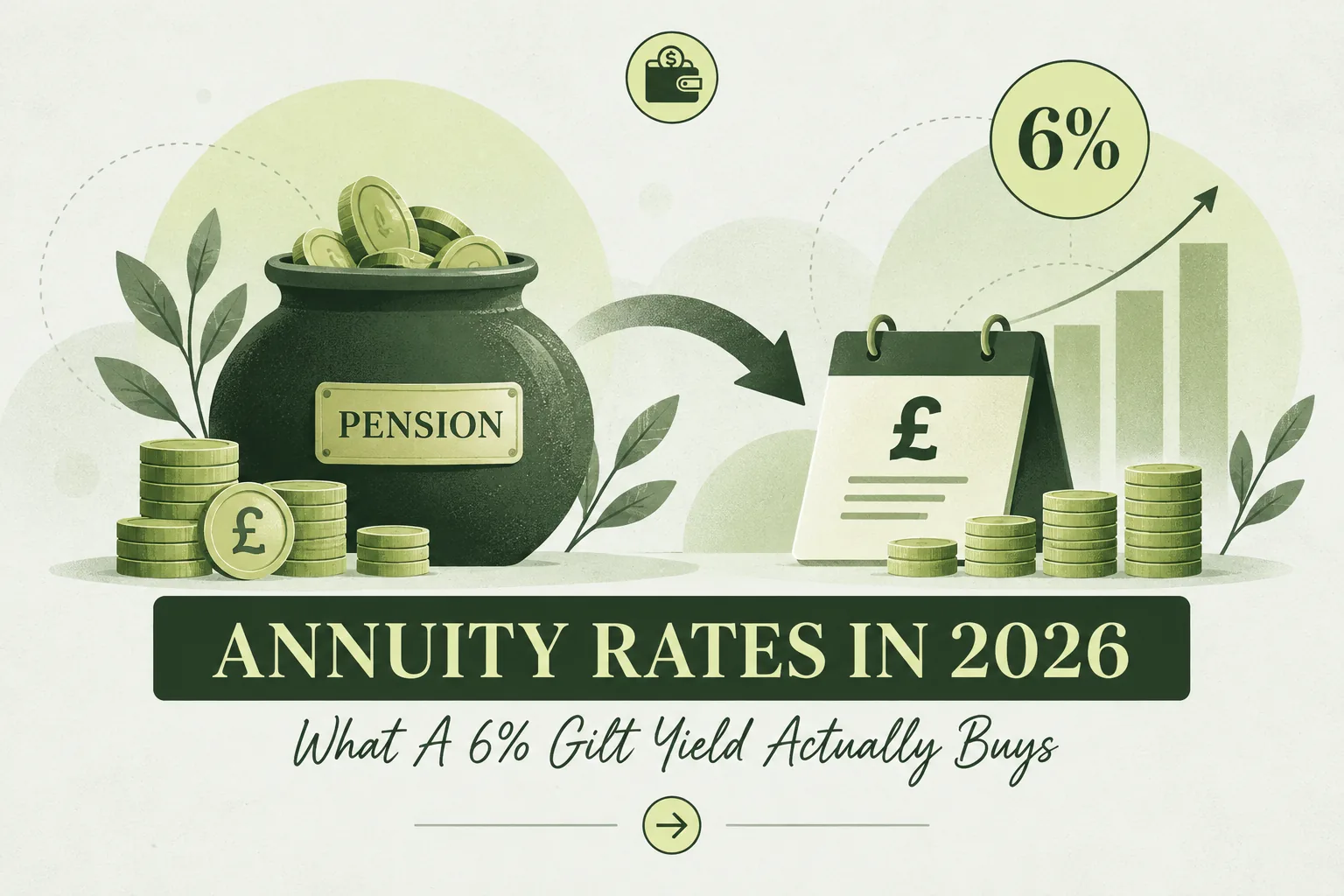
Insurers back the income they promise with long dated gilts and corporate bonds. When those yields rise, the same pension pot buys more guaranteed income, so annuity quotes improve. After the 30 year gilt briefly passed 6% in October 2026, annuity rates sit far above the levels of the mid 2010s. Quotes still vary by provider, age and health.
What Actually Happened In The Gilt Market
A gilt is a loan to the UK government. You buy it, it pays a fixed rate of interest, and it repays the face value on a set date. Because that interest payment is fixed, the only way the market can reprice a gilt is through its price, and price and yield move in opposite directions. When investors demand more compensation to lend for 30 years, the price of existing long gilts falls and the yield rises.
That is what happened through the first week of October 2026. The 30 year gilt passed 6% on 1 October for the first time since 1998, then rose again to 6.036% on 7 October, up 13 basis points on the day. The 10 year gilt reached 5.48%, just short of its highest level since 2007. The move formed part of a global bond selloff, with investors focused on inflation and on the scale of government borrowing ahead of the Budget on 28 October. Long yields have come off that peak since, which is a useful reminder that a quote reflects the day it was produced.
| Measure | Level | Source and date verified |
|---|---|---|
| 30 year gilt yield, October peak | 6.036% | Reuters, 7 October 2026 |
| 10 year gilt yield, October peak | 5.48% | Reuters, 7 October 2026 |
| 30 year gilt yield since the peak | Eased back below 6% | Reuters, 16 October 2026 |
| Bank Rate | 3.75% | Bank of England, held 17 September 2026 |
| Next Bank Rate decision | Due 5 November 2026 | Bank of England, verified 17 October 2026 |
Sources: Reuters and the Bank of England. All figures verified 17 October 2026.
Notice the gap in that table. Bank Rate stood at 3.75% while the 30 year gilt yielded 6.036% at the October peak. The Bank of England sets one very short term rate and publishes it alongside each decision. Everything beyond a year or two is priced by investors instead, and that longer part of the curve is what an annuity is built on.
How Annuity Rates Are Really Set
An annuity is a contract. You hand a lump sum to an insurer and it promises to pay you an income, in most cases for the rest of your life. To keep that promise for somebody who might live another 30 years, the insurer needs assets that pay out over the same sort of horizon. In practice it buys long dated gilts and corporate bonds and matches them against the payments it owes.
So the yield available on those bonds is the raw material of your quote. Fidelity describes the chain directly: because insurers back annuity income mainly with long term corporate bonds and gilts, higher yields on those holdings let them offer new annuities at more attractive rates. That is why annuity rates track the long end of the gilt curve much more closely than they track Bank Rate.
Bond yields are only one input, though. MoneyHelper, the guidance service backed by government, sets out the rest of what moves a quote.
Your age at purchase
The older you are when you buy, the shorter the expected payment period, so the same pot usually buys a higher income.
Your health and lifestyle
Medical and lifestyle questions are used to estimate life expectancy. An enhanced annuity can pay more where a condition, a manual job or a smoking history shortens it.
The shape you choose
A level income starts higher than one that rises each year. Adding a pension for a surviving partner, or a guarantee period, lowers the starting figure.
Market conditions on the day
Quotes move with bond yields, so the rate you are shown is a snapshot rather than a fixture.
A Worked Example On A £100,000 Pot
MoneyHelper uses the simplest possible illustration of the arithmetic. On a £100,000 pot, a 5% rate pays £5,000 a year and a 6% rate pays £6,000 a year. That is the whole mechanism in one line: one percentage point on the rate is worth £1,000 a year of income on this pot, for life.
Two things follow, and both are easy to miss. The first is that the lump sum you actually hand over is usually not the whole pot. You can normally take up to 25% of a pension as tax free cash, capped by the lump sum allowance of £268,275 according to GOV.UK. Take the full 25% from £100,000 and you are buying an income with £75,000, not £100,000.
£1,000 a year per percentage point
That is what one percentage point of annuity rate is worth on a £100,000 pot, using the illustration from MoneyHelper. On the £75,000 left after taking maximum tax free cash, the same percentage point is worth £750 a year instead.
The second is that annuity income is taxable. It is paid as income and taxed like other pension income, so the tax free cash decision and the annuity decision sit better considered together than one after the other. If you want to frame what the same money might do if it stayed invested instead, our compound interest calculator is a faster way to see the shape of that comparison than arguing about it in the abstract.
Compare the UK platforms that hold a SIPP, side by side.
Capital at risk.
Where People Get Annuity Rates Wrong
Most of the confusion about annuity rates comes from four places, and none of them is complicated once it is named.
Reading a headline rate as your rate
A published rate is an average or a best case. Age, health, postcode and the options you add all move the figure you are actually offered.
Assuming the quote will keep
Quotes are priced off bond yields that move daily, so a figure from three weeks ago is history rather than an offer.
Comparing a level annuity with an increasing one
A level income starts higher and stays flat. MoneyHelper notes that £200 a month rising by a fixed 3% a year would pay around £261 a month after 10 years, so the starting figures are not comparable.
Asking only your existing provider
MoneyHelper advises comparing what different providers will offer, even where your own provider quotes a guaranteed annuity rate.
What The Numbers Say About How Retirees Actually Choose
The FCA publishes retirement income market data every year. The edition published on 24 September 2026 covers the year to 31 March 2026, and it shows annuities growing from a small base. Annuity purchases rose 13.2% to 100,144, up from 88,430 the year before. Plans entering drawdown rose 10.5% to 401,137, up from 362,946, on the FCA figures.
Source: FCA retirement income market data 2025/26, published 24 September 2026. Verified 12 October 2026.
So annuities are growing faster in percentage terms, while drawdown stays roughly four times more common. The same release records that 45.8% of pots accessed for the first time were fully encashed, down from 47.4%, and that 30.8% of first time accesses involved regulated advice.
30.8% took regulated advice
That is the share of pension plans accessed for the first time in the year to 31 March 2026 where the holder took regulated advice, on the FCA figures. Close to seven in ten did not.
How This Looks On A UK Platform
If the pot sits in a SIPP, buying an annuity usually happens in two stages. You tell the platform how much tax free cash you want, then the remaining funds are sold and the proceeds are transferred to the insurer that issues the annuity. Some platforms run an annuity service in house, some hand you to a specialist, and some do not support annuity purchase at all, so the practical question is what your own provider offers. Our Hargreaves Lansdown review covers how one of the larger SIPP providers handles the retirement end of an account.
Two mechanical points are worth knowing before you start. Selling funds takes time to settle, so the quote you were shown may have moved by the time the cash is ready. And the decision to stop paying in is a separate question from the decision to buy an income: we looked at what stopping pension contributions actually costs if you are weighing both at once.
See how the main UK investment platforms compare on cost and features.
Capital at risk.
Frequently Asked Questions
Not automatically, but the link is direct. Insurers back annuity income with long dated gilts and corporate bonds, so a higher yield on those assets lets them price new annuities more generously. Longevity assumptions and competition between insurers also feed into a quote, so rates do not move in lockstep with the gilt market.
No. An annuity in payment is a fixed contract. The rate was set when you bought it, and later movements in gilt yields do not alter it. That cuts both ways: you are protected if yields fall, and you do not benefit if they rise.
Usually up to 25% of the pension, subject to the lump sum allowance of £268,275 according to GOV.UK. Taking the full 25% means you are buying income with the remaining 75%, which is the most common reason a quote comes back lower than people expect.
Only inside the cooling off period. MoneyHelper states that most annuities have a 30 day cooling off period and that after this an annuity cannot be cancelled. That is why the decision deserves more time than the expiry date on a quote tends to allow.
There is no general answer, because the two solve different problems. An annuity removes investment risk and the risk of outliving the pot, and gives up flexibility and any residual value. Drawdown keeps flexibility and growth potential, and keeps the risk that the pot runs down. FCA data for the year to 31 March 2026 shows drawdown is still roughly four times more common.
Because they are different things. Bank Rate is the single short term rate the Bank of England sets. Long gilt yields are set by investors who want extra compensation for lending for decades, and that compensation has risen. Annuity pricing follows the long end of the curve rather than Bank Rate.
Key Takeaways
Annuity rates follow the long end of the curve
Insurers match promised income with long dated bonds, so the 30 year gilt yield matters far more to a quote than Bank Rate does.
The 30 year gilt reached 6.036% on 7 October 2026
That was its highest level since January 1998, and although it has eased back since, annuity pricing is a live question again after a decade in which it mostly was not.
One percentage point is worth £1,000 a year per £100,000
Using the illustration from MoneyHelper. On the 75% left after taking maximum tax free cash, the same percentage point is worth £750 a year.
A quote is personal and perishable
Age, health, postcode and the options you choose all move it, and so do bond yields between the quote and the purchase.
The decision is close to irreversible
MoneyHelper states that most annuities carry a 30 day cooling off period and cannot be cancelled after it ends.
Sources: Reuters, the Bank of England, the Financial Conduct Authority retirement income market data 2025/26, GOV.UK and MoneyHelper. Gilt and Bank Rate figures verified 17 October 2026, all other figures verified 12 October 2026.
This article is for education and general information only. It is not financial advice or a personal recommendation. Investments can fall as well as rise and you may get back less than you put in. An annuity is a long term commitment that is usually irreversible once the cooling off period ends. Tax rules depend on your circumstances and can change. If you are unsure, consider taking regulated advice.