













Trading.com Review 2026: Fees, Safety & Verdict
The Investment Account, tested against their own documents

By David Katzarov, Editor
Published: | Fact-checked by: Dimitar Kanazirski | Last updated:

Your capital is at risk. Promotional credit cannot be withdrawn. Other charges may apply. Eligibility and T&Cs apply.
What will you find in this review:
Invest in shares and ETFs with £50 promotional credit and zero dealing commission
Your capital is at risk. Promotional credit cannot be withdrawn. Other charges may apply. Eligibility and T&Cs apply.

Capital at risk. Advertisement.
Trading.com Review UK: Fees, Safety and Who It Suits
Trading.com is a broker authorised and regulated by the Financial Conduct Authority, offering UK investors an Investment Account where you can invest in real shares and ETFs, held on your behalf through a nominee structure, with no dealing commission.
Trading.com also offers other account types, but we have not covered them here. Our focus is entirely on services aimed at long term investors, so this review deals only with the Investment Account.
We have gone through Trading.com’s own pricing documents, terms and conditions and FCA register entry to set out what it costs, what protections apply, and what the account does and does not include.

Quick verdict
Trading.com’s Investment Account offers commission free dealing in real shares and ETFs, subject to applicable charges such as currency conversion fees and transaction taxes. There is no published platform or custody fee, and a variable rate is paid on uninvested cash if you opt in. The firm has been authorised and regulated by the Financial Conduct Authority since May 2016.
The catch for UK investors is the missing tax wrapper. There is no stocks and shares ISA and no SIPP. Holding investments outside an ISA may result in tax being payable on investment gains or income, depending on your circumstances and applicable allowances. If you still have ISA allowance available, it is worth comparing the potential tax advantages of investing through an ISA before choosing a general investment account.
Who it suits
- Investors who have already used their ISA allowance and want commission free share and ETF dealing
- People who want to hold cash and shares in one place and earn interest on the uninvested balance
- Anyone comfortable with a smaller fund range who mainly wants large UK, European and US shares plus core ETFs
Who it does not suit
- Investors who want to use their available ISA allowance before investing through a general investment account
- Investors who want a SIPP or a junior account
- People who want a wide fund choice, as the ETF list runs to 62 funds
- Anyone who wants a monthly direct debit, as there is no regular investing facility
Start investing with £50 promotional credit and zero dealing commission on shares and ETFs.
Your capital is at risk. Promotional credit cannot be withdrawn. Other charges may apply. Eligibility and T&Cs apply.
Your capital is at risk. Promotional credit cannot be withdrawn. Other charges may apply. Eligibility and T&Cs apply.
How we reviewed Trading.com
We think you should know exactly what a review is based on, so here is our scope.
This review is built from Trading.com’s own published material: the Investment Account terms and conditions, the Costs and Charges document, the product and pricing pages on trading.com/uk, and the firm’s entry on the FCA Financial Services Register. Every fee figure below is taken from Trading.com’s own documents, with the version and date recorded so you can check it yourself.
We also registered an account to observe the sign up and onboarding process first hand.
What we have not done is fund an Investment Account and place live trades. Where something can only be confirmed inside a funded account, such as whether fractional shares are available, we say so rather than guessing. We will update this review once we have tested it directly.
Who is Trading.com?
Trading.com is the trading name of Trading.com Markets UK Limited, a company incorporated in England and Wales (number 09436004) with a registered office at Coppergate House, 10 Whites Row, Spitalfields, London E1 7NF.
The firm has a longer UK history than the brand name suggests. According to the FCA register it has been authorised since 3 May 2016, originally as Trading Point of Financial Instruments UK Limited. Between June 2016 and August 2019 it traded in the UK under the name XM. It began trading as Trading.com in July 2019 and formally changed its registered name to Trading.com Markets UK Limited in January 2025.
That matters for one reason: the firm is not a start up. It has held a UK licence for around a decade under various names, which is a longer track record than several of the app first brokers it competes with.
The wider group also holds licences in Cyprus (CySEC), Australia (ASIC) and the United States (CFTC and NFA). Those cover different legal entities. As a UK resident you deal with the UK entity and are covered by UK rules.
How is Trading.com regulated, and what protections apply?
FCA authorisation
Trading.com Markets UK Limited is authorised and regulated by the Financial Conduct Authority under firm reference number 705428. You can check this yourself on the FCA register, and we would encourage you to, for reasons covered further down.
Its permissions include dealing in investments as agent and as principal, arranging deals, and safeguarding and administering client assets. It is permitted to hold and control client money.
What FSCS protection actually covers
Trading.com Markets UK Limited is covered by the Financial Services Compensation Scheme for eligible investment claims. If the firm were to fail and you had an eligible claim, compensation may be available up to the applicable FSCS investment limit, currently £85,000. FSCS protection does not cover losses arising from the performance of your investments.
One point is worth clarifying, because the two limits are often confused. The FSCS limit rose to £120,000 on 1 December 2025, but that increase applies to cash deposits held with banks, building societies and credit unions. The £120,000 deposit protection limit should therefore not be confused with the separate limit applicable to eligible investment claims.
How your shares are held
Your investments are held in safe custody, registered in the name of a nominee company rather than in your own name. You retain beneficial ownership of the investments, while legal title is held through the nominee structure. Any gains or losses in the value of those investments remain attributable to you.
Two consequences are worth understanding, both set out in Trading.com’s terms. Your holdings are pooled with those of other clients rather than held in separately identified accounts. Trading.com’s terms acknowledge that if a shortfall arises in the pooled holdings and cannot be covered, clients may share the loss proportionally. Nominee structures and pooled custody arrangements are commonly used by UK investment platforms, but it is not the same as holding shares in your own name.
Because holdings sit in a pooled nominee, shareholder perks may not be claimable, and you will not automatically receive company reports and accounts. Voting is possible by proxy if you ask.
Trading.com’s terms also confirm it will not lend your investments to third parties or use them as collateral.
Check you are dealing with the real firm
The FCA register lists seven cloned firms that have used Trading.com’s details to impersonate it. These are scams run by third parties, not by Trading.com, and the same thing happens to most established brokers.
How to protect yourself
- Search the FCA register for firm reference number 705428
- Use the contact details listed on the register, not details sent to you in an email or message
- If someone contacts you claiming to be Trading.com and the details do not match, do not engage
Trading.com fees explained
All figures below are taken from Trading.com’s Costs and Charges document, version 5, dated 2 July 2026, and the Investment Account terms and conditions, version 1, dated 27 March 2026.
The headline
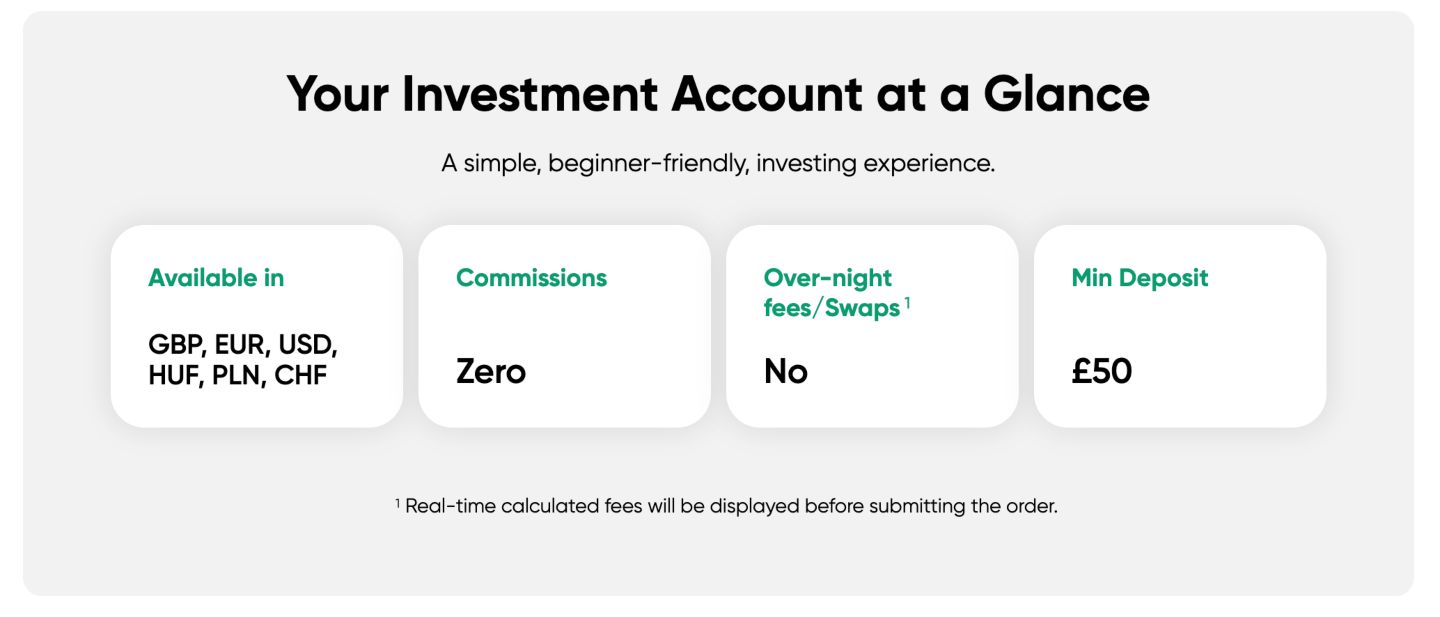
There is no dealing commission on shares or ETFs in the Investment Account, and no custody or platform fee is published. There is also no inactivity fee published for the Investment Account. Other charges still apply, including currency conversion and government taxes, which are set out below.
| Charge | Amount | When it applies |
|---|---|---|
| Dealing commission | £0 | All share and ETF trades |
| Currency conversion | 0.25% of trade value | Buying or selling anything not in your account currency |
| UK stamp duty | 0.50% | Buying UK shares. A government tax, not a Trading.com charge |
| PTM levy | £1.50 | Buying or selling UK shares worth more than £10,000 |
| French transaction tax | 0.40% | Buying French shares |
| Italian transaction tax | 0.20% | Buying Italian shares |
| Spanish transaction tax | 0.20% | Buying Spanish shares |
| Custody or platform fee | None published | |
| Inactivity fee | None published | For the Investment Account |
What this costs in real money
Percentages are easy to skim past, so here is what they come to on realistic trades.
| Trade | What you pay | Total cost |
|---|---|---|
| £1,000 of a US share | 0.25% conversion each way | £5.00 round trip |
| £1,000 of a UK share | 0.50% stamp duty on the buy | £5.00 round trip |
| £15,000 of a UK share | Stamp duty £75 plus PTM levy both ways | £78.00 round trip |
| £5,000 of a US dollar ETF | 0.25% conversion each way, no stamp duty | £25.00 round trip |
The number that matters for regular investors
If you are investing regularly into US or global ETFs, the currency conversion charge is the main ongoing cost to account for. Investing £1,000 a month into a dollar denominated ETF works out at roughly £30 a year in conversion charges, on the assumptions above. You can model this against other platforms with our UK broker fees calculator.
Zero dealing commission applies to the trade itself, and currency conversion is charged separately. If overseas ETFs will form the bulk of your portfolio, it is worth comparing conversion charges across platforms. Our UK broker fees calculator lets you run the same trade across several providers.
One gap in the pricing
Trading.com does not publish an execution spread or price improvement policy for Investment Account share dealing. The firm operates a best execution policy as required by FCA rules. There is no published spread figure, so the fee table above covers the charges Trading.com discloses rather than the full economics of a trade.
Zero dealing commission on shares and ETFs, with £50 promotional credit to start.
Your capital is at risk. Promotional credit cannot be withdrawn. Other charges may apply. Eligibility and T&Cs apply.
Your capital is at risk. Promotional credit cannot be withdrawn. Other charges may apply. Eligibility and T&Cs apply.
The offers, and what they are really worth
Trading.com runs three promotions on the Investment Account. Two are simple. One needs explaining.
The £50 promotional credit
Eligible new clients who register and verify an Investment Account receive £50 of promotional credit. Existing clients opening an Investment Account for the first time may also be eligible, subject to the applicable terms and conditions.
You can use it on any eligible share or ETF, and split it across more than one holding. You can sell what you buy with it straight away, and any profits are withdrawable subject to the applicable terms and conditions. The £50 promotional credit itself cannot be withdrawn. It is granted once per client, not per account, so closing and reopening does not get you a second one.
The deposit offer, and how the 5% works
The headline is “deposit and get up to £5,000 worth of shares and ETFs of your choice”. The rate behind it, stated on the same page, is 5% promotional credit on your deposits.
At 5%, here is what an eligible deposit earns, subject to the applicable terms and conditions.
| You deposit | Promotional credit |
|---|---|
| £500 | £25 |
| £1,000 | £50 |
| £5,000 | £250 |
| £10,000 | £500 |
| £100,000 | £5,000 |
The £5,000 figure reflects the maximum credit available, which corresponds to a £100,000 deposit. For an eligible client depositing £1,000, this would result in £50 of promotional credit, subject to the applicable terms and conditions.
The four conditions that determine how the credit works
Trading.com publishes the full mechanics in its own FAQ. We have set them out here because they determine when and how the credit becomes available.
1. Your own deposited funds are used first. When you place a trade, your cash balance is used before the credit. The credit becomes available once that balance has been fully invested. On a £5,000 deposit, the £250 credit applies after the £5,000 is invested.
2. Withdrawals reduce the credit proportionally. If you withdraw from your own balance, the credit is reduced in proportion to the amount withdrawn.
3. Unused credit expires after 180 days. Counted from your first qualifying deposit, after which it is removed automatically. Credit that becomes available again because you closed a position funded by it is also removed at that point.
4. Deposits qualify for 90 days. Deposits made more than 90 days after your first qualifying deposit do not earn further credit, so the deposits counting towards the maximum need to fall inside that window.
Taken together, the promotional credit works as additional investing capacity rather than as cash. It becomes available once your own deposited funds are invested, reduces proportionally if you withdraw, and expires if it is not used within the stated period. For someone depositing £1,000 and investing it promptly, it is worth £50. For someone who deposits and holds a cash balance, the credit may not be used before it expires.
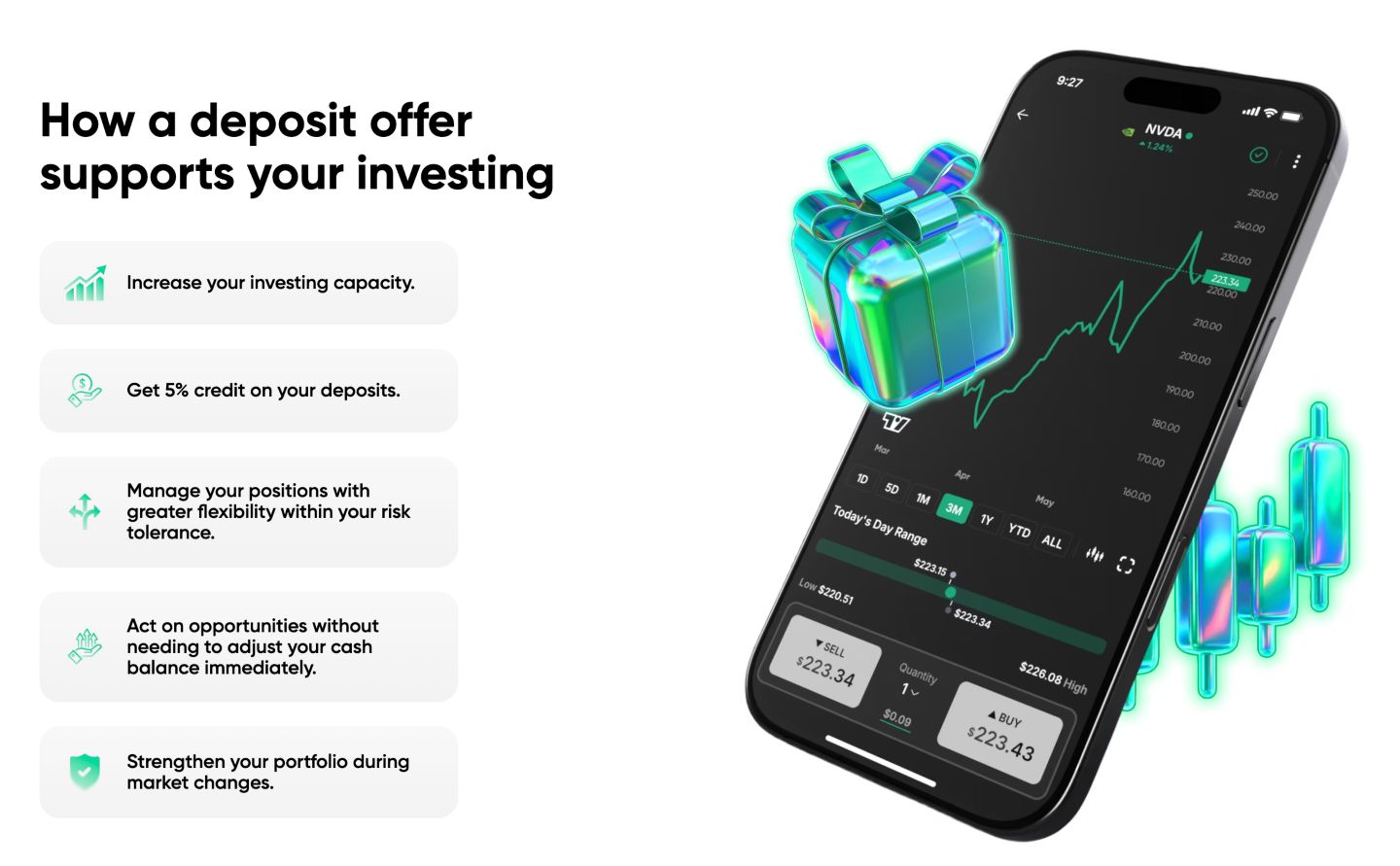
The promotional credit is restricted to buying shares and ETFs, cannot be withdrawn or transferred, and is available to verified UK Investment Account holders, both new and existing. Any profits you make using it are withdrawable subject to the applicable terms and conditions. Full terms are on Trading.com’s website.
Refer a friend
Eligible clients may receive £50 of promotional credit for each qualifying referral, subject to the referral programme’s eligibility criteria and terms and conditions.
Interest on uninvested cash
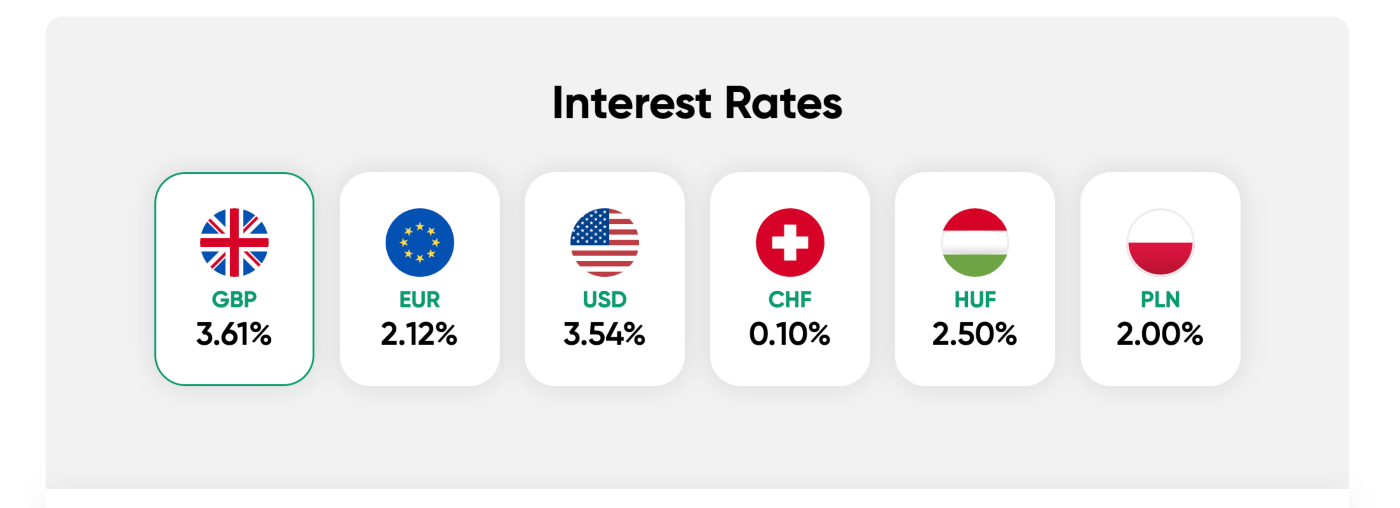
Trading.com advertises 3.61% AER on uninvested GBP cash in the Investment Account, correct as at 3 September 2026. Rates for other currencies are 3.54% on USD, 2.50% on HUF, 2.12% on EUR, 2.00% on PLN and 0.10% on CHF.
If you opt in to the programme, eligible cash is placed in qualifying money market funds. This is not a bank deposit, the rate is variable and your capital is at risk. FSCS deposit protection does not apply in the same way as it would to eligible money held with a bank or building society.
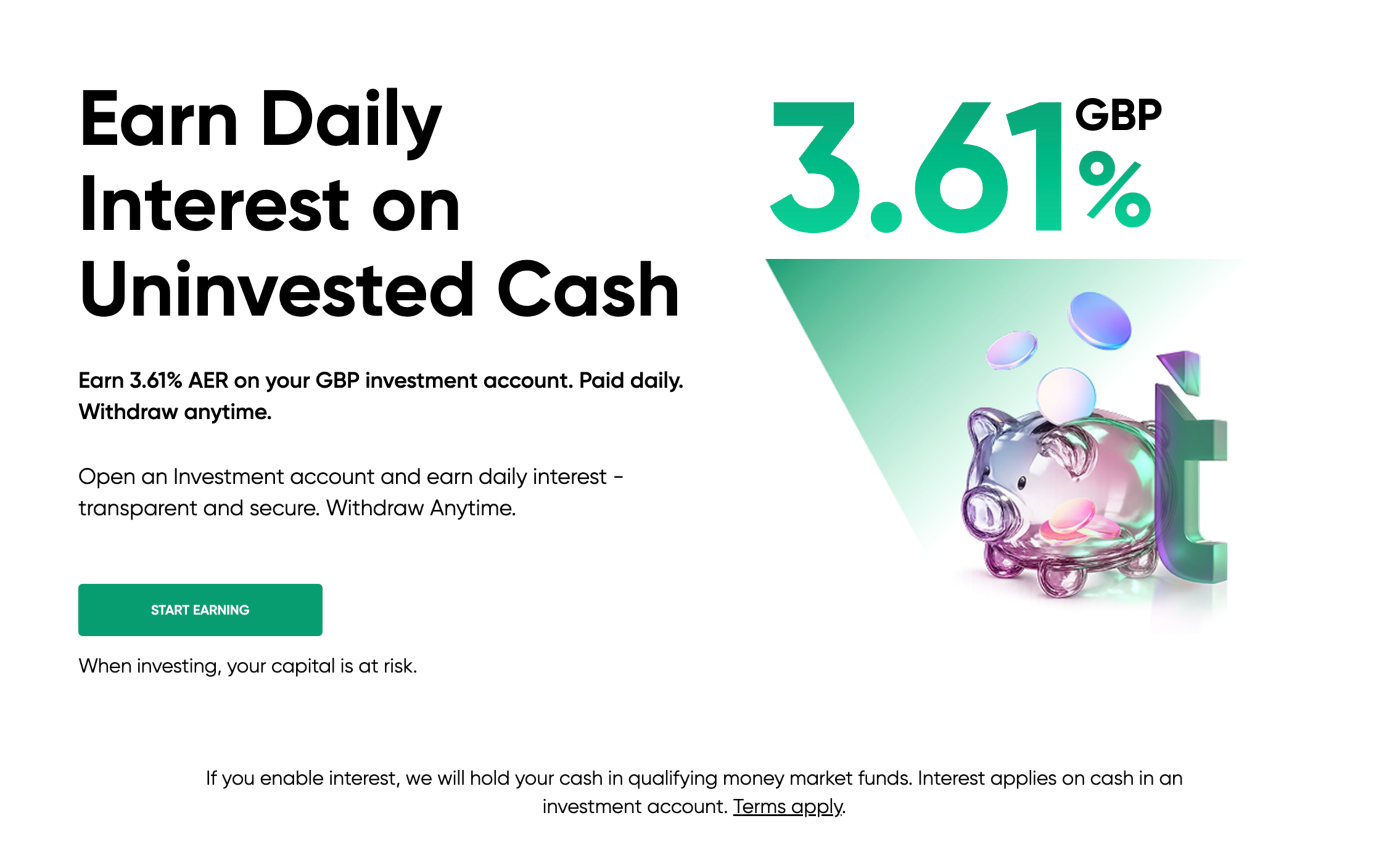
Interest is credited daily, there is no minimum or maximum balance, and you can withdraw or invest the money at any time.
A money market fund invests in short-term, high-quality assets and is widely used by pension funds and corporate treasurers. It is an investment rather than a bank account, but it is nothing unusual for providers to take advantage of QMMFs and provide a higher rate.
The programme is opt in, so you need to switch it on to receive interest. The advertised rate is the rate you receive, after Trading.com’s administration fee has been deducted from the return generated by the fund, a structure also used by other providers. The rate is variable and not guaranteed, with one day’s notice on a reduction and immediate application of an increase.
For cash you are holding between investments, the programme pays a return with daily crediting and no lock in period. It works differently from a savings account, so it is worth understanding the structure before you opt in. Whether it suits you depends on how much cash you hold, for how long, and your own view of the risk.
What you can invest in
The Investment Account covers listed shares in the UK, European Union and United States markets, plus ETFs.
ETFs
The ETF range runs to 62 funds, all UCITS, from Vanguard, iShares, Invesco and Amundi. That covers global equity, S&P 500, Nasdaq 100, emerging markets and a spread of bond funds. Both dollar and sterling share classes are available for some funds, which is useful if you want to avoid the conversion charge.
Sixty two is a small range compared with platforms offering several hundred or several thousand funds. If you want a specific niche or thematic ETF, it is worth checking it is on the list before you open an account. Our find your broker tool can help narrow the field if fund choice is your priority.
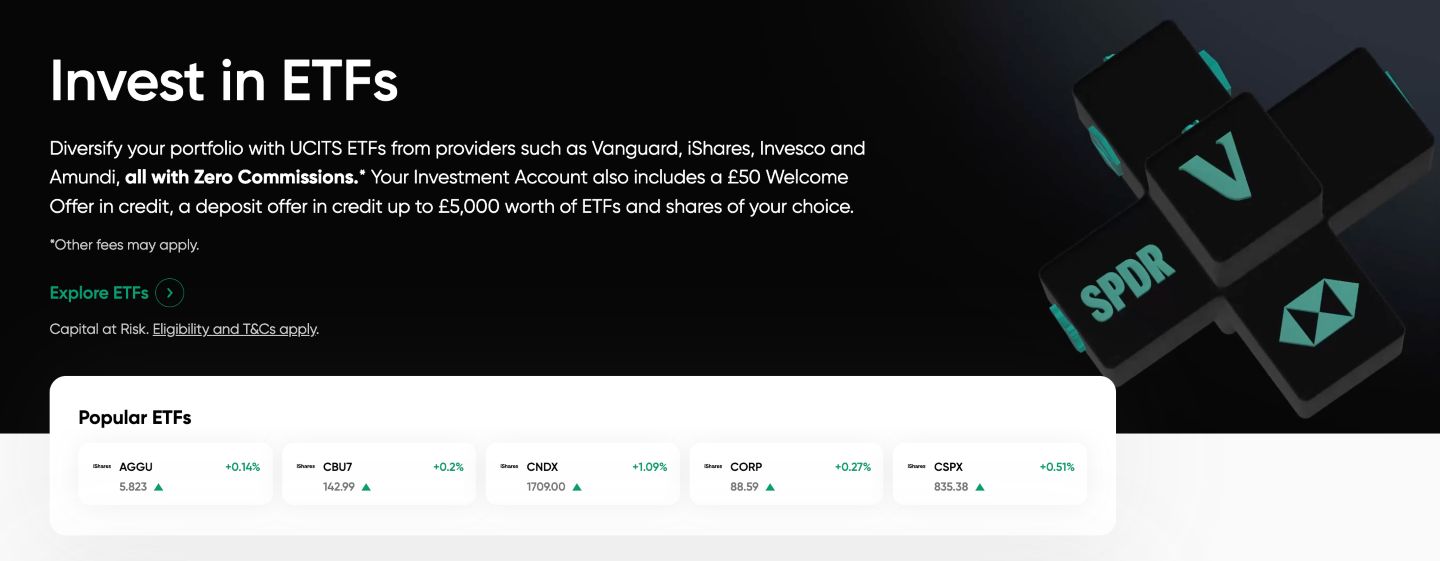
A Key Information Document is linked next to each fund in the ETF list, which is good practice and easy to overlook elsewhere.
Shares
Large UK, European and US shares are available. Short selling is not: Trading.com’s terms state that any order to sell shares you do not already hold will be rejected. This is a long only account. Fractional shares are not available either. Trading.com confirmed to us in August 2026 that it does not currently offer them and that they are planned, with no launch date given. In practice that means you buy whole shares, so if you invest a fixed amount each month you will be left with uninvested cash whenever the amount does not divide neatly into the share price.
Buying US shares: the W-8BEN step
To invest in US listed shares you need to complete a W-8BEN form. For eligible UK investors, completing a valid W-8BEN may reduce US dividend withholding tax from the standard 30% rate to the applicable UK to US treaty rate, currently generally 15%, subject to individual circumstances. The form is issued by the US Internal Revenue Service.
It takes a few minutes and the platform prompts you. It matters because Trading.com does not provide tax relief at source or help you reclaim withholding tax on foreign shares, so if you skip the form you simply pay the higher rate.
What is not available
There is no stocks and shares ISA and no SIPP. There are no funds beyond ETFs, no investment trusts listed as a category, no bonds bought directly, and no junior account. For a UK long term investor, the missing ISA is the single biggest limitation on this account. If you still have allowance available, our guide to the best stocks and shares ISAs covers the platforms that offer one, and our best SIPP providers page does the same for pensions.
Opening an account
The requirements are simple: you must be 18 or over, resident in the UK, and not a US person for tax purposes. The minimum deposit is £50.
Trading.com describes the process in three steps: register and verify your email address, mobile number and identity; create an account and select the Investment Account type; then fund it and start investing. On the web the sign up form asks for your country of residence, name, email address and a password, with two tick boxes, both unticked by default, one for marketing consent and one confirming you have read the legal documents and accept that calls are recorded. We note the marketing box being off by default, since opt out defaults are common in this sector.
At the account selection step Trading.com sets out what the Investment Account involves, and two details there are worth pulling out. The Investment Account requires no suitability questionnaire, and only one Investment Account can be opened per client.
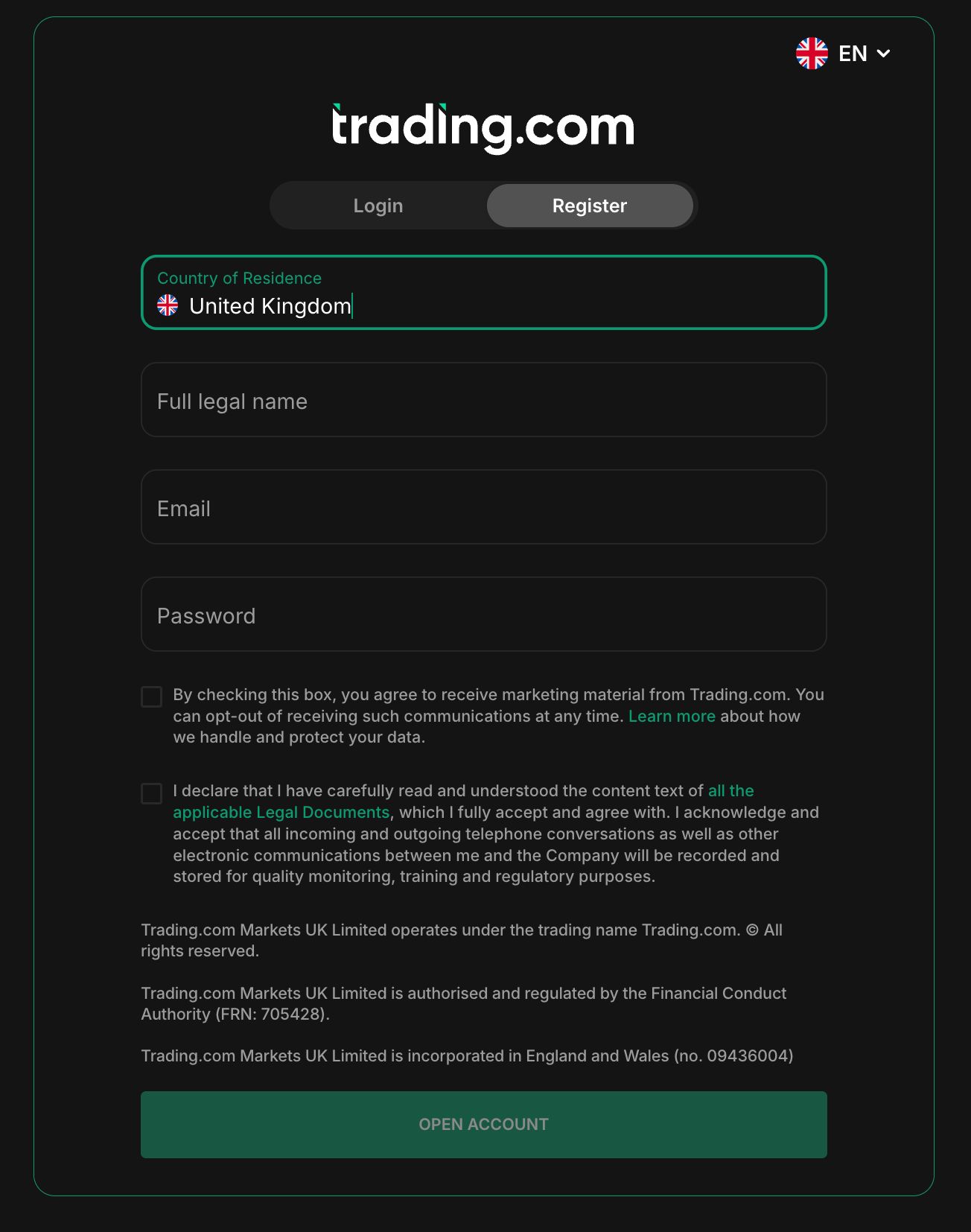
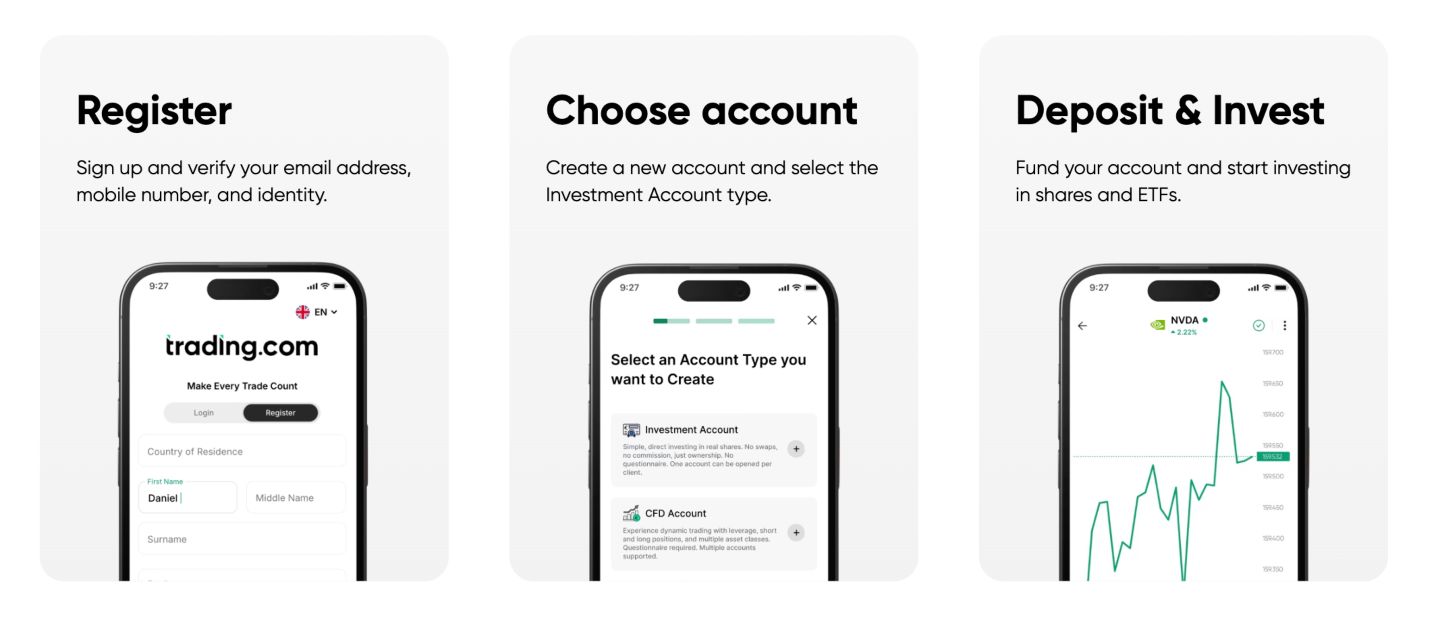
This reflects the execution only basis on which the Investment Account is provided, which meets the applicable regulatory requirements for this type of service. Trading.com does not provide investment advice or assess the suitability of individual investment decisions, so investors make their own investment decisions. The one account per client limit also rules out running separate pots, for example keeping a core portfolio apart from a more speculative one.
One point on the sign up journey. When we registered on the web we were not presented with an account type selector, and a practice account was created automatically. That remained the case after confirming the email address.
The selector may appear at a later step, or when adding a further account inside the platform. If you register with the intention of investing in shares, it is worth checking that an Investment Account has been opened before funding.
There is no practice mode for the Investment Account itself, so you cannot try it before committing real money.
You can fund by debit or credit card, or bank transfer. Third party payments and cash are not accepted, and the account must be in your own name.
Withdrawals go back to the source they came from. If you deposited by card, money returns to that card first, up to the total you deposited, working backwards from your most recent deposit. A standard good AML practice for brokers. Trading.com does not publish a withdrawal fee, though its terms reserve the right to introduce withdrawal limits and fees.
You have 14 days from account opening to cancel, though that right falls away if you have bought investments in the meantime. You can still sell up and close the account at any point without further charge.
Platform experience
Trading.com offers a browser based WebTrader, iOS and Android apps, and MetaTrader 5.
Charting is powered by TradingView, which is the same engine behind most serious retail charting packages and a step up from the basic line charts some commission free apps ship with. The interface splits instruments into categories with a search and filter, and there is an economic calendar, a daily market research feed, a glossary and a set of video tutorials.
MetaTrader 5 is also available. For someone buying a global tracker once a month it is not relevant, but it is there if you want it.
Customer support
Trading.com told us in September 2026 that UK clients are supported by dedicated UK Client Relations Officers available during UK business hours, 9:00am to 6:00pm, and that clients also have access to a dedicated account manager.
Trading.com’s website currently lists support as available Monday to Friday, 08:00 to 16:00 GMT+2, with a virtual assistant outside those hours, so the published hours and the UK desk hours differ. Contact is by email at support.uk@trading.com, with a switchboard number of +44 20 3150 2020 listed on the FCA register. Complaints go to compliance.uk@trading.com and can be escalated to the Financial Ombudsman Service.
Advantages and drawbacks
Advantages
- Zero dealing commission on shares and ETFs, and no published custody, platform or inactivity fee
- Authorised and regulated by the Financial Conduct Authority since May 2016
- Variable rate paid on uninvested GBP cash if you opt in, currently 3.61% AER, credited daily with no lock in
- Currency conversion at 0.25% is lower than several rivals
- Beneficial ownership retained through a nominee structure, and no stock lending
- Low £50 minimum deposit
- TradingView charting, and a Key Information Document linked to every ETF
- Marketing consent is off by default at sign up
Drawbacks
- No stocks and shares ISA and SIPP yet
- ETF range limited to 62 funds
- No regular investing or direct debit facility
- Limited availability of fractional shares (in development)
- Cash interest is paid via qualifying money market funds, which do not carry FSCS deposit protection
- Human support runs Monday to Friday only, ending in the early UK afternoon
- No practice mode for the Investment Account
How Trading.com compares
| Trading.com | Trading 212 | InvestEngine | Interactive Brokers | eToro | |
|---|---|---|---|---|---|
| Dealing commission | £0 | £0 | £0 on DIY | From USD 0.005 per share | £0 |
| Currency conversion | 0.25% | 0.15% | GBP ETF investing | 0.002%, min USD 2.00 | USD based account, charge applies unless you use the GBP account |
| Stocks and shares ISA | No | Yes | Yes | Yes | Yes |
| SIPP | No | Yes | Yes | Third party only | No |
| Interest on cash | 3.61% AER GBP | 3.8% AER GBP | None paid | 3.296% on GBP above £8,000 | See review |
| Minimum deposit | £50 | £1 | £100, top ups from £1 | None | Typically $50 |
Comparison based on publicly available provider information as at 3 September 2026. Trading.com figures from its Costs and Charges document v5 (2 July 2026) and product pages (10 August 2026); Trading 212 verified 5 August 2026; Interactive Brokers verified 2 July 2026; InvestEngine and eToro from our own reviews of each platform, sourced from provider pricing pages. Features, rates and charges can change. Different platforms may calculate charges or interest differently, so figures may not be directly comparable in all circumstances. Please check each provider’s current terms before making a decision.
On dealing costs Trading.com sits alongside the commission free names. Its 0.25% currency conversion charge is higher than Trading 212 at 0.15%, though the two are charged on the same basis. Interactive Brokers uses a different charging model, so the figures are not directly comparable.
On coverage it is the outlier. It is the only platform in this group with neither an ISA nor a SIPP. The absence of an ISA is an important consideration for UK investors who still have ISA allowance available, although the relevance will depend on individual circumstances. Our best stocks and shares ISA comparison sets out the alternatives.
On fund choice, Trading.com’s 62 ETFs sit below the ranges offered by several platforms in the table, some of which list several hundred funds. If you want a specific fund rather than a core tracker, it is worth checking the list first.
If the absence of an ISA is the deciding factor for you, our best stocks and shares ISA comparison sets out the platforms that offer one. You can also browse all of our broker reviews or answer a few questions in our find your broker tool.
Frequently asked questions
Trading.com Markets UK Limited is authorised and regulated by the Financial Conduct Authority under firm reference number 705428, and has been authorised since May 2016. Client money is held separately from the firm’s own funds and investments are held through a nominee structure. Regulation does not remove investment risk: the value of your investments can fall as well as rise and you may get back less than you invest. FSCS protection covers eligible claims if the firm fails, not losses from the performance of your investments.
Yes. Trading.com Markets UK Limited is authorised and regulated by the Financial Conduct Authority under firm reference number 705428, and has been authorised since May 2016.
No. The Investment Account is a general investment account only. There is no ISA and no SIPP, so gains and dividends are not tax sheltered and may be taxable depending on your circumstances.
There is zero dealing commission on shares and ETFs, and no published platform, custody or inactivity fee. Other charges still apply: a 0.25% currency conversion charge on trades in a currency other than your account currency, plus government charges such as 0.50% stamp duty on UK shares.
The minimum deposit is 50 pounds.
Trading.com Markets UK Limited is covered by the FSCS for eligible investment claims, currently up to £85,000, if the firm fails. FSCS protection does not cover losses arising from the performance of your investments. Client money is held separately from the firm’s own funds, and investments are held through a nominee structure. Cash placed in the interest programme sits in qualifying money market funds and does not carry FSCS deposit protection in the same way as money held with a bank.
3.61% AER on GBP as at 3 September 2026. The rate is variable, the programme is opt in, and eligible cash is placed in qualifying money market funds rather than held as a bank deposit. The advertised rate is what you receive, after Trading.com’s administration fee has been deducted from the fund return.
No. Trading.com confirmed to us in August 2026 that fractional shares are not currently available on the Investment Account, and that it plans to introduce them, though no launch date has been given. For now you buy whole shares only, so a single share of an expensive US company costs whatever that share costs.
Yes. You can transfer investments to another provider once they have settled, or sell up and withdraw the cash to your nominated bank account.
The platform is straightforward to use and the £50 minimum deposit is low. As the Investment Account is provided on an execution only basis, Trading.com does not provide investment advice or assess the suitability of individual investment decisions, so investors need to make their own decisions. There is also no ISA, so investors with unused ISA allowance may wish to compare the potential tax advantages of investing through an ISA first.
Final verdict
Trading.com’s Investment Account covers the basics. Zero dealing commission on real shares and ETFs, a 0.25% currency conversion charge, no published platform fee, and a variable rate on uninvested cash if you opt in.
Where it is more limited is coverage rather than cost. There is no ISA, no SIPP, 62 ETFs, no fractional shares and no regular investing facility.
Our view: Trading.com may be worth considering as a general investment account, particularly for investors looking for commission free share and ETF dealing. The lack of an ISA, SIPP and regular investing facility should be considered alongside its pricing and available investment range.
Interested in Trading.com? Open an Investment Account and receive £50 promotional credit if eligible.
Your capital is at risk. Promotional credit cannot be withdrawn. Other charges may apply. Eligibility and T&Cs apply.
Your capital is at risk. Promotional credit cannot be withdrawn. Other charges may apply. Eligibility and T&Cs apply.
How we review brokers
This review follows the same process we apply to every broker, so you can see what the verdict above is actually based on.
- What we assessCost, safety and regulation, investment range, platform experience, account options, and support.
- Where it comes fromFee schedules, key features documents, terms and conditions, and the FCA Register.
- How often we checkAt least quarterly, and sooner when a broker changes its charges or accounts.
- IndependenceCommercial relationships do not change our verdict, or what we write about a broker.