












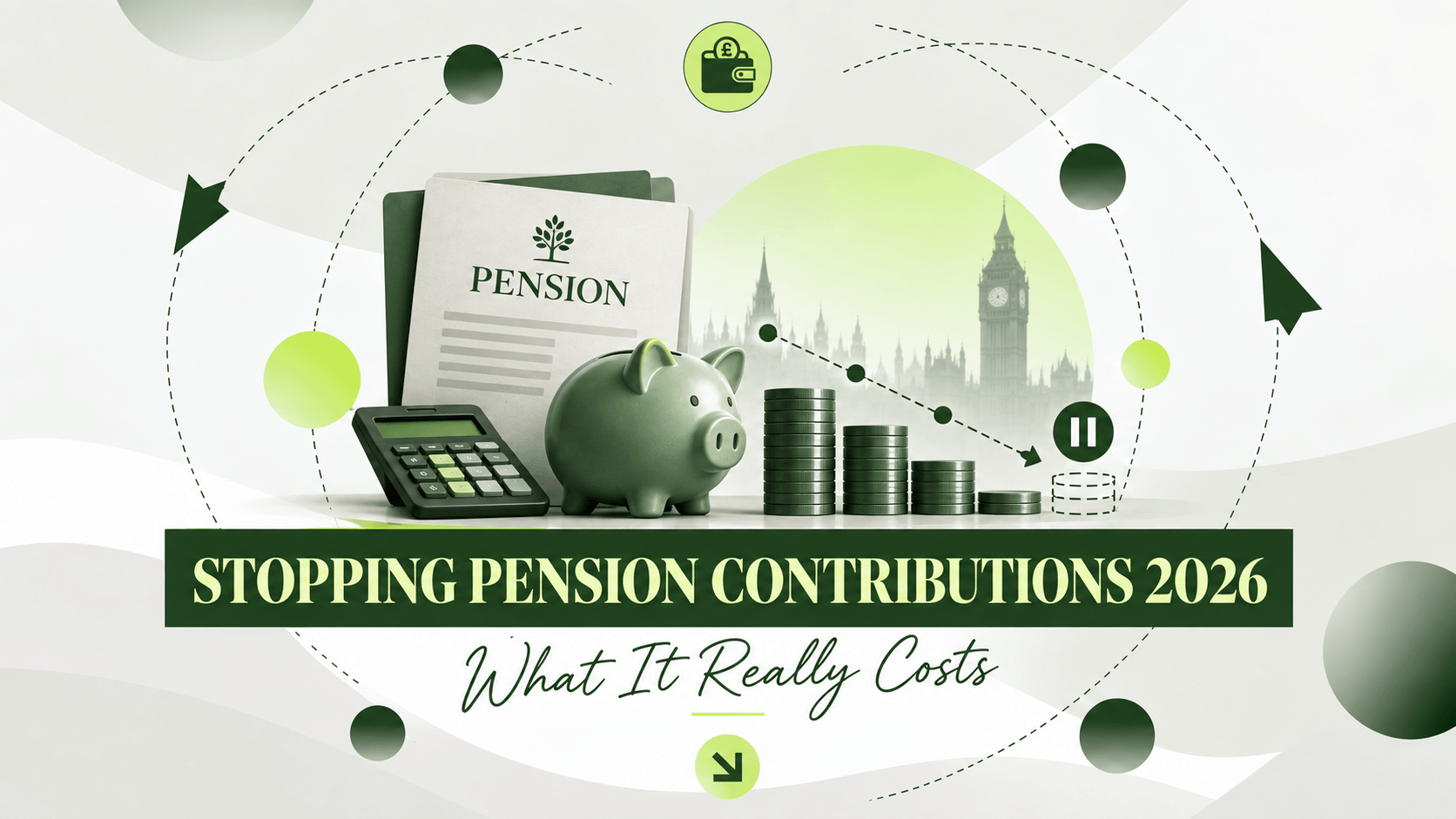
Stopping Pension Contributions 2026: What It Really Costs

Introduction
Research published in September 2026 by the wealth manager Raymond James found that around one in six of the 3,000 savers it surveyed had stopped paying into a workplace pension in the previous twelve months. That sample was not a cross-section of the country, because everyone in it earned at least £39,000 and held at least £1,000 in accessible savings. The finding still matters, because stopping pension contributions is the one money decision that looks free in the month you make it and expensive for the thirty years afterwards.
This guide sets out what actually happens to the money when you stop your pension contributions, using the statutory rules as they stand in the 2026/27 tax year. It is not a judgement on anyone’s budget. If the choice is between a pension contribution and an expensive overdraft, the pension can wait. But most people who pause their pension contributions do it without knowing the size of what they hand back, and the size is the genuinely surprising part.
This article is for information and education only and is not financial advice. Investments can fall as well as rise, and you may get back less than you put in. Pension and tax rules depend on your individual circumstances and can change. If you are unsure, consider taking regulated financial advice.
Quick Answer: What Stopping Pension Contributions Costs
At the statutory minimum your workplace pension receives 8% of your qualifying earnings, of which only 4% comes from your own take-home pay. Stopping pension contributions therefore removes two pounds from the pot for every one pound you keep, and your employer is required to enrol you again within three years.
How A Workplace Pension Contribution Is Built
A workplace pension under automatic enrolment is not a single payment from you. It is three payments, and only one of them is yours.
The legal minimum, unchanged since 6 April 2019, is a total contribution of 8% of qualifying earnings, of which the employer must provide at least 3%. The remaining 5% comes from your side, and part of that 5% is tax relief rather than your own money.
Qualifying earnings is the phrase doing the real work here, and it does not mean your whole salary. For the 2026/27 tax year it means the slice of pay between £6,240 and £50,270. The earnings trigger that brings you into automatic enrolment in the first place is £10,000. The Department for Work and Pensions confirmed on 18 December 2025 that all three figures would stay at their 2025/26 levels.
| Element | Statutory minimum | On a £35,000 salary |
|---|---|---|
| Qualifying earnings | Pay between £6,240 and £50,270 | £28,760 |
| Employer contribution | At least 3% | £862.80 a year |
| Your contribution | 5% | £1,438.00 a year |
| Of which tax relief | 20% of your 5% at basic rate | £287.60 a year |
| Cost to your take-home pay | 4% of qualifying earnings | £1,150.40 a year |
| Total into the pension | 8% | £2,300.80 a year |
Source: The Pensions Regulator and the Department for Work and Pensions, 2026/27 automatic enrolment thresholds and statutory minimum contributions. Verified 28 September 2026.
The One For Two Trade Most People Never See
Here is the part that changes the decision. Of the 5% coming from your side, a basic rate taxpayer funds only four fifths. The other fifth is tax relief, added either by the scheme under a relief at source arrangement or by the deduction happening before Income Tax under a net pay arrangement. Either way the arithmetic lands in the same place.
Five percent of qualifying earnings, less 20% basic rate relief, is 4% of qualifying earnings out of your take-home pay. The pension still receives 8%. So a basic rate taxpayer paying the statutory minimum gives up one pound of spendable income for every two pounds that arrives in the pension.
One pound of take-home pay, two pounds in the pension
At the statutory minimum a basic rate taxpayer funds 4% of qualifying earnings from spendable income while the pension receives 8%. The ratio is fixed by the rules, not by investment returns.
GOV.UK puts the same mechanism in cash terms. On a contribution of £40 from you and £30 from your employer, the government adds £10, and £80 reaches the pension.
Very little else in personal finance doubles your money on the day you pay it in. That doubling is not an investment return and it carries no market risk, because it is simply how the scheme is built.
A Worked Example On A £35,000 Salary
Take somebody earning £35,000 who pauses pension contributions for a single year at the statutory minimum.
Their qualifying earnings are £28,760, so the pension would have received £2,300.80 over that year. Their own share of it, after basic rate tax relief, is £1,150.40, which works out at roughly £96 a month.
The pause therefore puts about £96 a month back in their pocket. In exchange, £2,300.80 does not reach the pension, and half of that was never their money to begin with.
What you keep: £1,150.40
Roughly £96 a month of take-home pay, for the twelve months of the pause.
What the pension loses: £2,300.80
The whole year at the 8% statutory minimum on qualifying earnings of £28,760.
What nobody gets back: £1,150.40
Employer money of £862.80 and tax relief of £287.60. This is not deferred to a later year. It is simply never paid.
What One Missed Year Is Worth At Retirement
The missed pension contributions are only the first half of the cost. The rest is the growth that money would have had while it sat there.
The chart below shows what a single missed year of £2,300.80 could be worth at retirement, at an illustrative 5% a year, for somebody with different lengths of time still to run. Twenty five years out, one paused year is worth roughly £7,800.
Chart: YourWalletManager, compounding a single missed year of £2,300.80 at 5% a year. The contribution figure is the 2026/27 statutory minimum on qualifying earnings of £28,760. Verified 28 September 2026.
The 5% is an assumption rather than a forecast. Real returns vary, charges reduce them, and inflation reduces what the final figure buys. The shape of the chart is the point: the cost of a pause is set less by the amount than by how long you have left.
See what one paused year does to a pot over a full working life.
Capital at risk.
Where People Get Stopping Pension Contributions Wrong
Three rules catch people out, and all three sit in The Pensions Regulator’s own guidance rather than anywhere obvious.
Opting out and stopping are not the same thing
You have one month from the start of your opt-out period to serve a valid opt-out notice. Serve it in time and you are treated as never having joined.
After one month there is no refund route
Once the window closes you cannot opt out at all. You cease active membership instead, and the contributions already made stay in the scheme until you can access the pension.
You will probably be put back in
Employers must re-enrol eligible staff roughly every three years, choosing a date inside a six month window around the third anniversary of their duties start date.
On refunds the regulator’s wording is specific. A valid opt-out notice served inside the window means contributions must be returned within one month of the notice, or by the last day of the second applicable pay reference period where payroll had already closed. Miss the window and that route is gone.
Re-enrolment carries one exception worth knowing. An employer may choose to leave out somebody who opted out or ceased membership within the twelve months before the re-enrolment date. Stop more than twelve months before it and you must be put back in if you still qualify.
How This Looks Alongside A SIPP
Your employer chooses the workplace scheme, so you cannot move it to a platform of your own while you are still contributing to it. Two things are worth checking on the workplace side before you do anything. First, whether your employer pays more than the 3% minimum. Second, whether reducing your own contribution would reduce theirs, because some schemes match pound for pound up to a ceiling, in which case a cut costs you twice.
A SIPP is the account you choose yourself, and it is usually where old workplace pots end up being consolidated rather than a replacement for the scheme paying you employer money. If comparing SIPP providers is the more useful exercise, our AJ Bell review covers one of the larger UK options, and our platform comparison sets them side by side.
Compare the UK platforms that offer a SIPP, side by side.
Capital at risk.
Reducing Instead Of Stopping Pension Contributions
The rules do not force a binary choice. Paying less than before but more than nothing keeps you an active member, keeps employer money flowing at whatever level your scheme matches, and avoids the cessation question entirely.
It also keeps you out of the odd position of having stopped, been re-enrolled three years later, and then having to make the same decision again from scratch.
If the retirement arithmetic is what you are really trying to settle, our FIRE calculator is more use than any rule of thumb, and our guide to state pension tax covers what the other half of retirement income looks like.
Frequently Asked Questions
Yes. Nobody can be forced to stay in a pension scheme. What changes is the route and the consequence. Inside the one month opt-out period you serve an opt-out notice and your contributions come back. After it you cease active membership instead, and the money stays invested until you can access it.
Only if you opt out within the opt-out period. The Pensions Regulator requires the refund within one month of a valid opt-out notice, or by the last day of the second applicable pay reference period where payroll had closed. After the window there is no refund route.
It stays invested in the scheme and it remains yours. Stopping pension contributions does not close the pot or forfeit what is in it. It only stops new money arriving.
Usually, yes. Employers must re-enrol eligible staff roughly every three years, on a date they choose inside a six month window around the third anniversary of their duties start date. They may leave out anybody who stopped within the previous twelve months.
That depends on your scheme. Where your employer matches your contribution, cutting yours may cut theirs, so check the scheme rules first. Staying an active member at a lower rate does keep the employer contribution and the tax relief running on whatever you still pay.
No. It is 8% of qualifying earnings, which for the 2026/27 tax year means the slice of pay between £6,240 and £50,270. On a £35,000 salary that is £28,760, so the total minimum contribution is £2,300.80 a year rather than £2,800.
Key Takeaways
The minimum is 8% of qualifying earnings, not of salary
For the 2026/27 tax year qualifying earnings means pay between £6,240 and £50,270, with the employer providing at least 3%.
You fund 4% and the pension receives 8%
For a basic rate taxpayer at the statutory minimum, one pound of take-home pay puts two pounds into the pension.
One paused year on a £35,000 salary costs £2,300.80
Half of that was employer money and tax relief, and none of it is deferred to a later year.
Reducing keeps the machinery running
An active member at a lower rate keeps employer contributions and tax relief on whatever is still paid in. Check whether your scheme matches before cutting.
Sources: Department for Work and Pensions written statement HCWS1206, 18 December 2025; The Pensions Regulator, automatic enrolment earnings thresholds; The Pensions Regulator detailed guidance 7, opting out; The Pensions Regulator detailed guidance 11, automatic re-enrolment; GOV.UK, workplace pensions; Raymond James research as reported on 21 September 2026. All verified 28 September 2026.
This article is for information and education only and is not financial advice. Investments can fall as well as rise, and you may get back less than you put in. Pension and tax rules depend on your individual circumstances and can change. If you are unsure, consider taking regulated financial advice.