













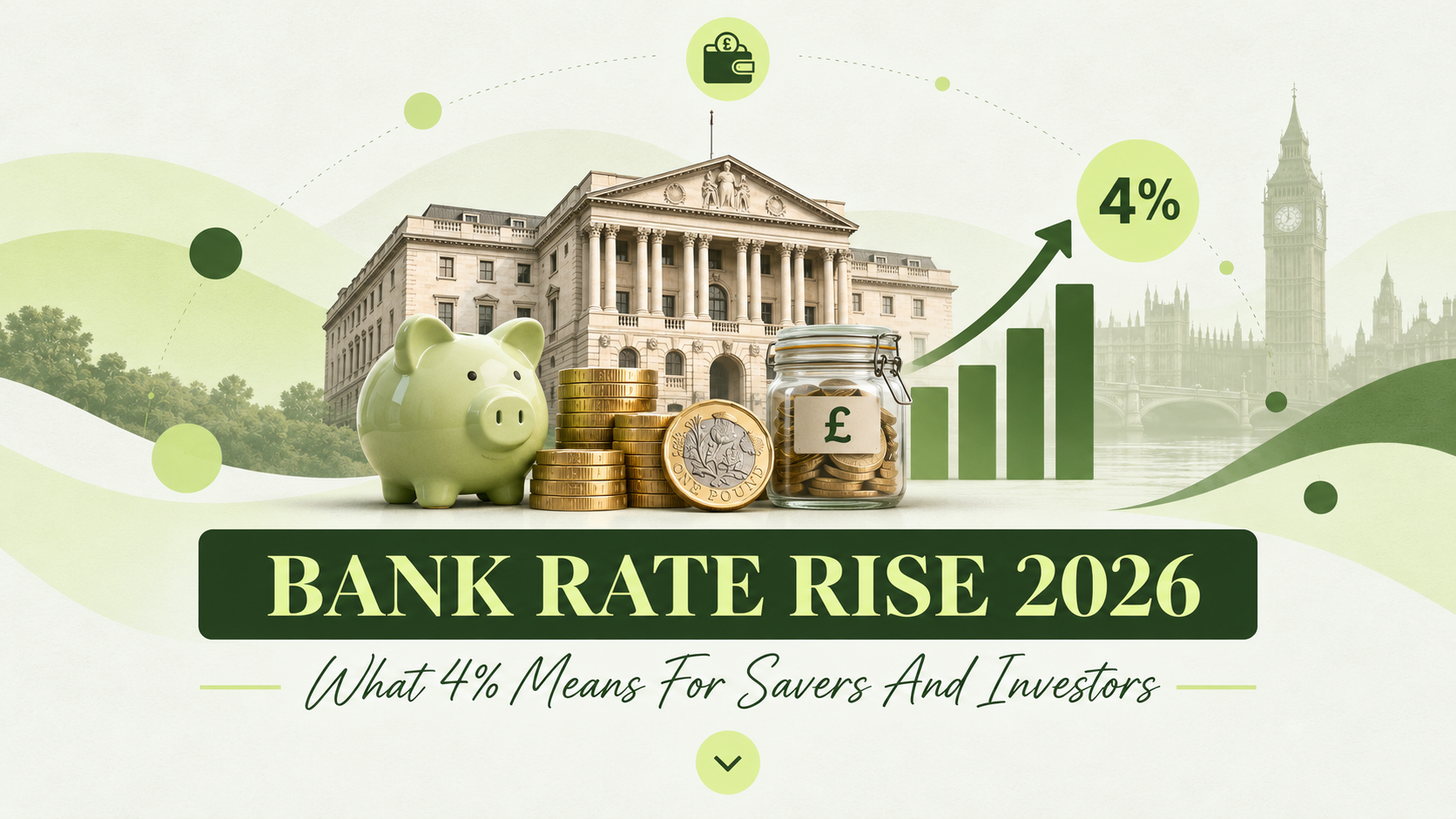
Bank Rate Rise 2026: What 4% Means For Savers And Investors
The Bank of England raised Bank Rate from 3.75% to 4% on 5 November 2026, the first increase since August 2023. Here is what the decision actually reaches…
7 min readRead guide

Compare platforms
Head-to-head broker comparisons
Still deciding?
See which platforms fit your goals
Broker reviews
Choose a UK investing platform
Our top picks
Not sure which platform suits you?
Answer a few questions and see which UK platforms fit your goals.
Broker reviews
Choose a UK investing platform
 eToro
 IG
 Interactive Brokers
 Freetrade
 Vanguard UK
 Trading 212
 AJ Bell
 Trading.com
 Lightyear
 Webull UK
 XTB UK
 Robinhood UK
 Hargreaves Lansdown
 Interactive Investor
 InvestEngine
Every review covers fees, account types, safety and FCA regulation, and is updated as providers change their pricing.
Knowledge hub
Guides for UK investors
Topics
Ready to start investing?
Answer a few questions and see which UK platforms fit your goals.
Overview, highlights & more!

By Dimitar Kanazirski, Editor-in-chief
Published: | Fact-checked by: David Katzarov | Last updated:
This YourWalletManager review looks at IG from a UK investor’s perspective: the share dealing account, Stocks and Shares ISA, Junior ISA, SIPP and managed Smart Portfolios, what they cost, and who they suit. Every figure was checked against IG’s own published material on 5 November 2026.
IG is best known for spread betting and CFDs, but it also runs a full investing service with no commission on shares and ETFs and no platform fee on its ISA or general account.
The catch is currency. With dealing free, the 0.7% FX fee on overseas shares is effectively what you pay to invest in US and European companies, and that is the number to weigh against rival platforms.
The information provided on this page and throughout the website is for general information purposes only and does not constitute financial advice. It is important that you conduct your own research and consider your own personal circumstances before making any investment decisions.
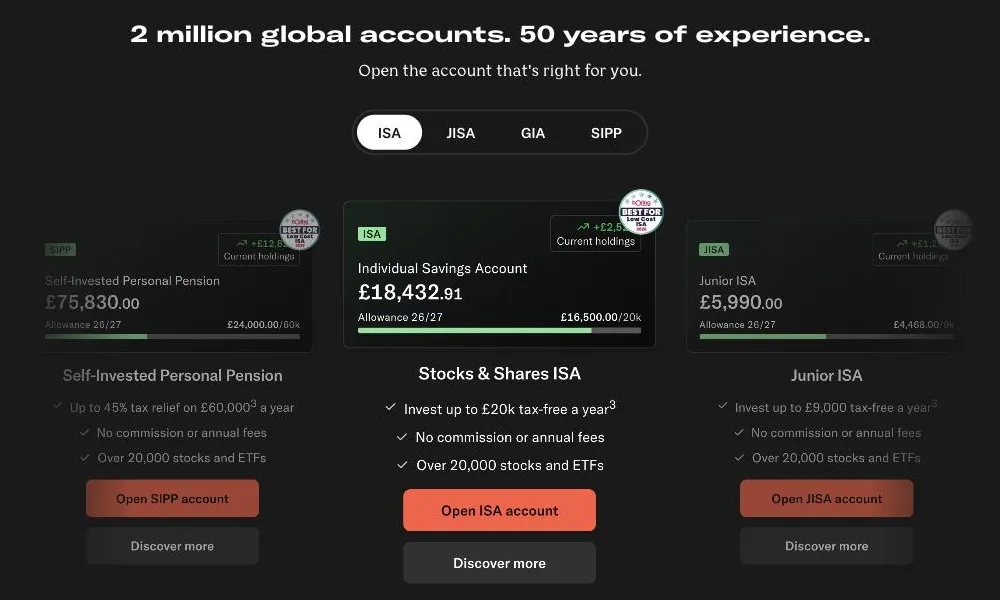
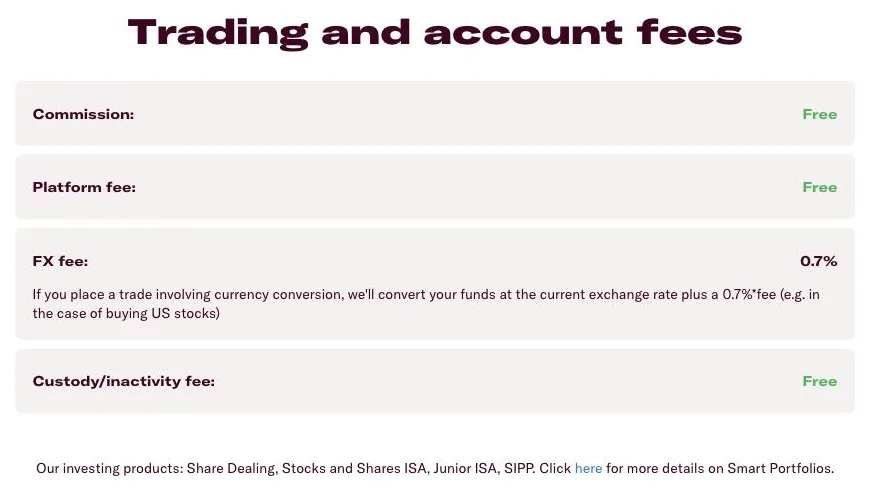
IG offers commission-free dealing on more than 20,000 shares and ETFs across the UK, US, Europe and Australia, according to IG, in a General Investment Account, a flexible Stocks and Shares ISA, a Junior ISA and a SIPP. There is no platform, custody or inactivity fee on the GIA, ISA or Junior ISA. The main cost is a 0.7% FX fee whenever a trade involves converting currency, such as buying US shares.
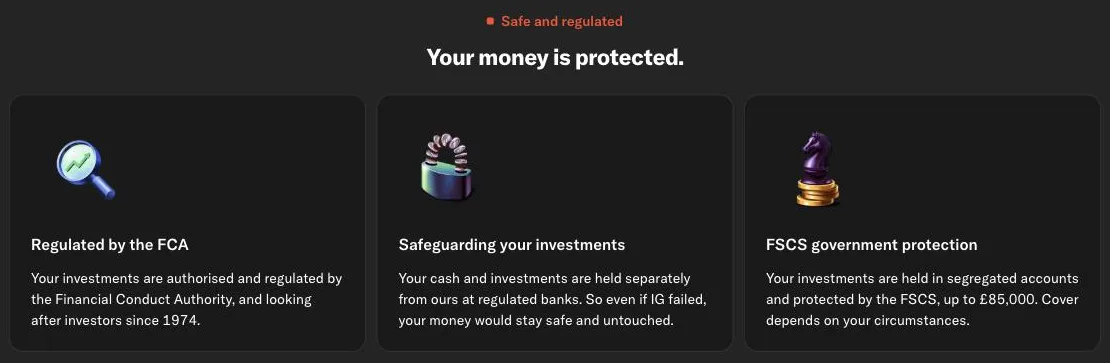
Investing accounts are provided by IG Trading and Investments Ltd, authorised and regulated by the FCA under register number 944492. FSCS investment protection applies up to £85,000 per person if the firm fails, and does not cover investment losses.
Uninvested sterling earns 3.75% AER variable on up to £100,000, provided you held, bought or sold an investment in the previous 30 days. The SIPP is run by a third-party administrator. IG’s SIPP page now lists no annual fee for a self-managed SIPP and £210 a year for a Smart Portfolio SIPP, but its charges page and SIPP FAQs still quote £210 for every SIPP and a £10,000 minimum to open (or a regular plan above £1,000 a month), so confirm both before you apply. Managed Smart Portfolios charge 0.50% on the first £50,000, capped at £250 a year per account type.
It suits investors who mainly buy UK-listed shares and ETFs, want a low-cost ISA that pays interest on cash, or want an inexpensive managed portfolio. It does not suit anyone who buys US shares often, wants funds (OEICs), needs a Cash ISA, or wants to start a SIPP with less than £10,000.
IG is a trading and investment company listed on the London Stock Exchange. It says it has 50 years of experience and more than two million accounts worldwide.
Most people know it for leveraged trading. This review deals with the other side of the business: share dealing, a Stocks and Shares ISA, a Junior ISA, a SIPP and managed Smart Portfolios, all provided by IG Trading and Investments Ltd.
IG Group also owns the Freetrade investing app, having completed the acquisition on 1 April 2025.
A long record and a large group are reassuring, but neither is a forecast. Past performance is not a reliable indicator of future results.
Investing at IG is built around two numbers: nothing in commission, and 0.7% on currency conversion. Add 3.75% AER variable on uninvested cash and it compares well for UK shares and ETFs held in an ISA, where there is no dealing or platform charge at all, and less well for US shares, where Trading 212 charges 0.15% and Lightyear 0.1% for the same conversion.
The strengths are cost and coverage: no commission, no platform fee on the ISA or general account, more than 20,000 shares and ETFs, interest on cash, all the core investing accounts, and managed portfolios with a fee that stops rising at £250 a year.
There are real drawbacks. The 0.7% FX fee is high for anyone buying overseas shares, the SIPP needs £10,000 to open according to IG’s SIPP FAQs and can carry a £210 annual administrator fee, and there are no funds (OEICs) or Cash ISA. IG’s own pages are not always consistent on details such as the SIPP fee and the number of shares available, so we note where figures differ.
This review is written for a UK reader and covers IG’s investing service only. IG also offers spread betting and CFDs through separate companies. These are complex, leveraged products: 70% of retail investor accounts lose money when trading spread bets and CFDs with this provider, according to IG at the time of writing. They are not covered in this review.
IG’s investing accounts sit with IG Trading and Investments Ltd, a different company from the ones that provide its leveraged products. That separation matters, because the accounts, protections and costs described in this review all relate to that entity.
Client shares are held through Citi as sub-custodian, and client money is kept in segregated accounts at banks including Barclays and Lloyds, separate from IG’s own funds.
Fractional shares are available from £1 on more than 6,400 stocks, but only in the General Investment Account, not in the ISA or SIPP.
| 🗺️ Market access | Over 20,000 shares and ETFs across the UK, US, Europe and Australia (IG figure) |
| 📊 UK and European shares | £0 commission online; published rates apply to trades up to £25,000 |
| 🇺🇸 US shares and ETFs | £0 commission, plus the 0.7% FX fee on the currency conversion |
| 💲 Currency conversion | 0.7% added to the exchange rate |
| ⏳ Inactivity fee | None |
| 🏧 Withdrawal fee | None, unless a currency conversion is needed |
| 💵 Minimum deposit | None for share dealing; the SIPP needs £10,000, or more than £1,000 a month |
| 💷 Interest on uninvested cash | 3.75% AER variable on GBP up to £100,000, with a 30-day activity condition |
| 💡 Products | Shares, ETFs, investment trusts, fractional shares (GIA only), Smart Portfolios |
| 🧾 Account types | GIA, Stocks and Shares ISA, Junior ISA, SIPP |
| 🎮 Demo account | Not for share dealing |
| 📜 UK regulator | FCA, register number 944492 |
IG offers four investing accounts, and the GIA, ISA and SIPP can each be self-directed or run as a managed Smart Portfolio. The costs and conditions differ more between them than IG’s headline of no commission and no account fees suggests.
The standard taxable account. There is no commission on stocks and ETFs traded in a UK GBP account, no platform fee, no custody fee and no inactivity fee. It is also the only IG account that offers fractional shares, from £1 on more than 6,400 stocks. Gains and income sit outside a tax wrapper, so UK tax applies in the normal way.
IG’s ISA is flexible: you can withdraw money and pay it back in during the same tax year without using up more of your £20,000 allowance. You can split the allowance between a self-directed share dealing ISA and a Smart Portfolio ISA, and move cash between them. There is no platform fee and no commission on shares and ETFs, and ISA transfers in and out are free.
When you open an ISA, IG also creates a share dealing account alongside it to act as an admin account. If a holding stops being ISA-eligible, it is moved there.
Cash inside the ISA. IG pays interest on uninvested ISA cash, and it stays tax-free: a planned 22% charge on cash interest in Stocks and Shares ISAs from April 2027 was cancelled in the Autumn Budget on 28 October 2026. Use our Stocks and Shares ISA calculator to see what the tax wrapper is worth on your own numbers.
Tax rules apply, tax treatment depends on your individual circumstances, and the rules may change.
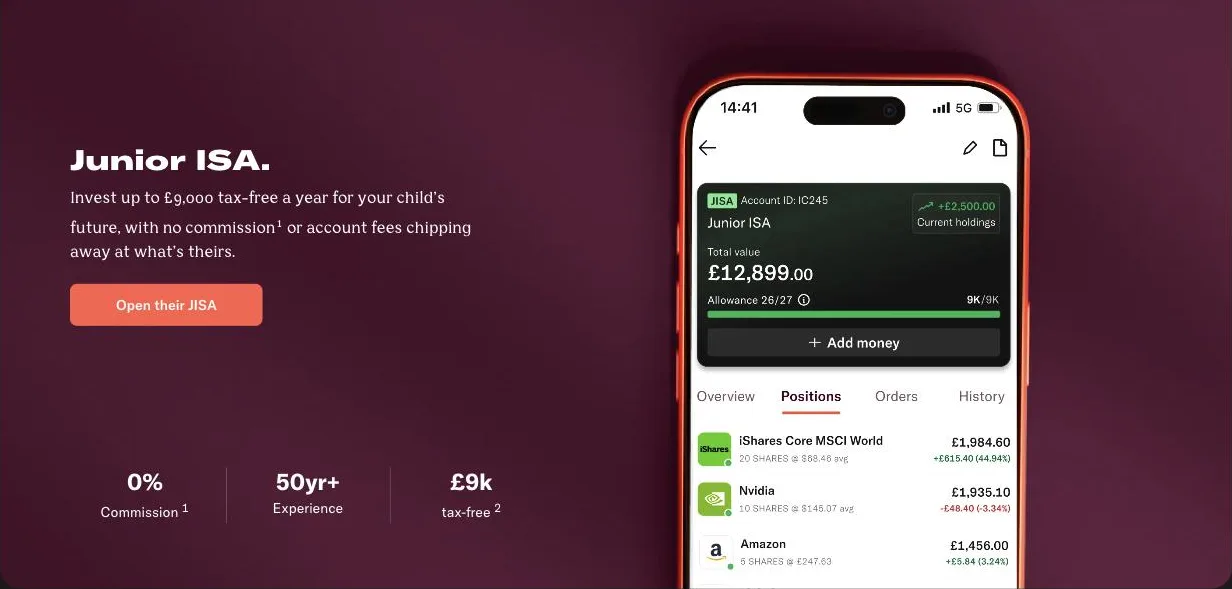
A stocks and shares Junior ISA with a £9,000 annual allowance, commission-free dealing and no account fee. A parent or legal guardian opens it and needs an IG account first. IG currently accepts applications for children under 14, so it is not an option for an older teenager. There is no minimum contribution, and the money is locked until the child turns 18, when it becomes an adult ISA in their name. IG offers no Cash Junior ISA.
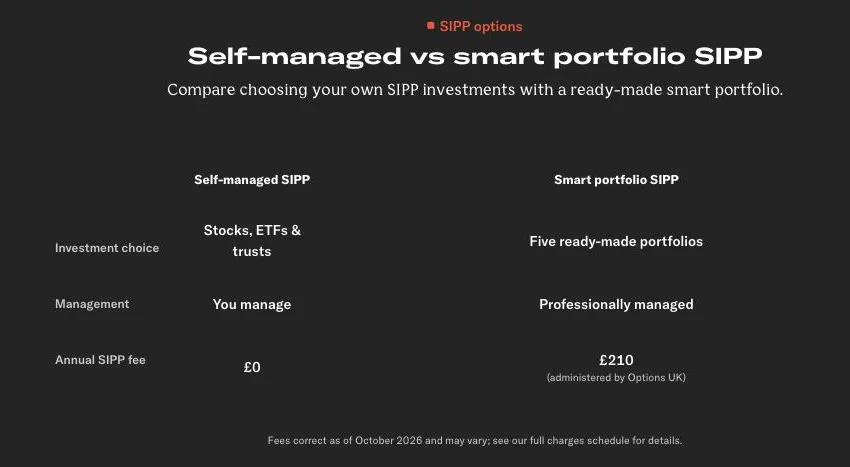
IG’s SIPP can be self-directed through the share dealing platform, managed as a Smart Portfolio, or both, with one of each allowed. The pension itself is set up and administered by a separate company, and what that costs depends on which IG page you read. IG’s SIPP page, with fees stated as correct as of October 2026, shows an annual SIPP fee of £0 for a self-managed SIPP and £210 for a Smart Portfolio SIPP, administered by Options UK. IG’s charges page and SIPP FAQs still say the administrator charges a £210 annual administration fee including VAT on every IG SIPP, with the first fee taken from the money you transfer or pay in and later fees deducted once a year. Ask IG to confirm the fee for the SIPP you want before you open it.
IG’s own website is not consistent about who that administrator is. Its SIPP pages and SIPP FAQs name Options UK Personal Pensions LLP, with MK SIPP Trustees UK Ltd as trustee, while its charges page names Pathlines Pensions UK. Pathlines Pensions UK Ltd is the former London & Colonial, renamed in October 2024. Both name a £210 fee, although the SIPP page now applies it only to the Smart Portfolio SIPP.
IG’s SIPP FAQs set a high entry point, although its redesigned SIPP page no longer mentions it. To open the SIPP you need at least £10,000, either as a transfer from another pension or as a single contribution, or a regular plan of more than £1,000 a month paid by standing order. Opening usually takes three to five days, and pension transfers in take around four weeks on average. Transfers from a defined benefit (final salary) scheme are only accepted if a qualified financial adviser has recommended them.
Where the £210 applies, it is a flat fee: 1.05% a year on a £20,000 pension but 0.21% on £100,000, so it gets cheaper in percentage terms as the pot grows. Compare it with other options in our guide to the best SIPP providers. Pension scams often target people moving pensions, and the FCA publishes guidance on how pension scams work.
IG offers no Cash ISA, no Lifetime ISA and no Innovative Finance ISA. Mutual funds (OEICs and unit trusts) are not available either, so anyone building a portfolio of funds rather than ETFs will need another platform. If a Cash ISA matters to you, see our guide to the best Cash ISAs.
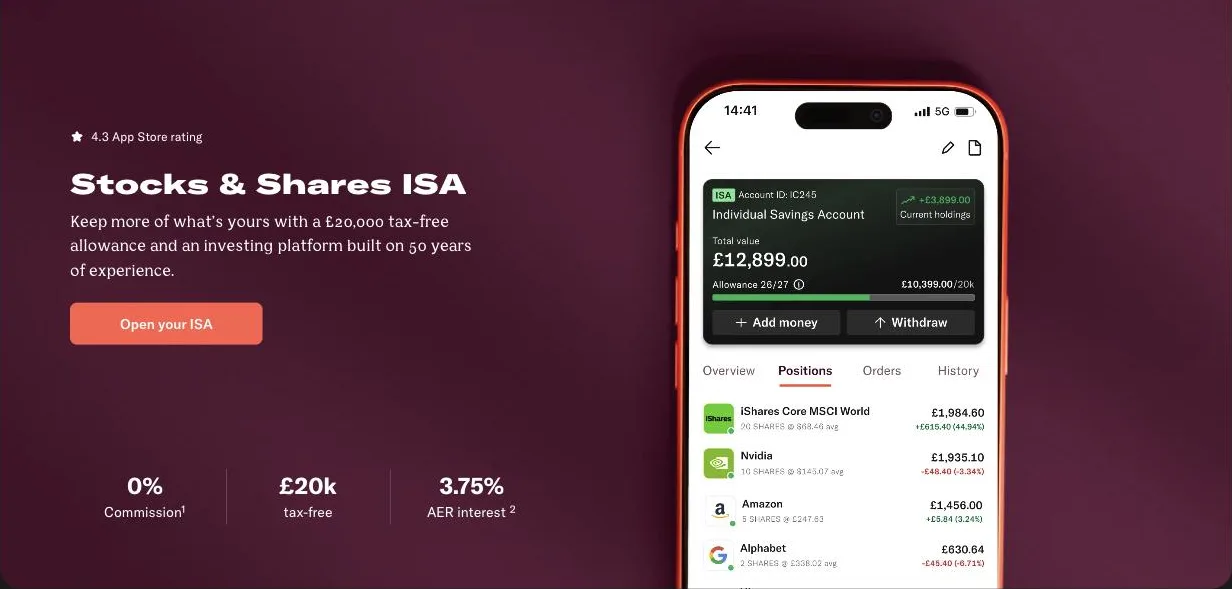
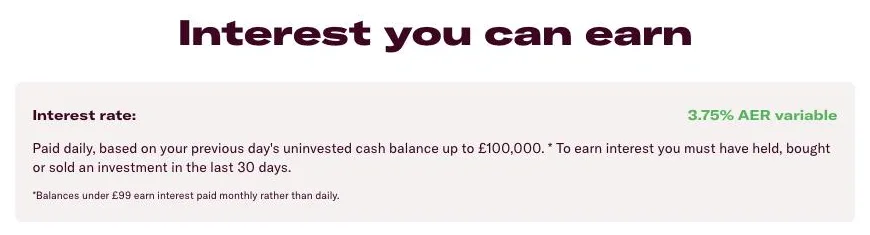
IG pays 3.75% AER variable on uninvested sterling in share dealing and Smart Portfolio accounts, across the GIA, ISA and SIPP. The rate is delivered as a nominal 3.681% compounded daily. Interest on share dealing accounts is paid every day, weekends included; on Smart Portfolio accounts it is calculated daily and paid monthly.
Three conditions do most of the work:
These rules took effect on 14 September 2026; before then, IG’s condition was based on activity within the calendar month. Interest in a GIA is taxable income. Interest inside an ISA is tax-free. The rate is variable and IG can change it at any time.
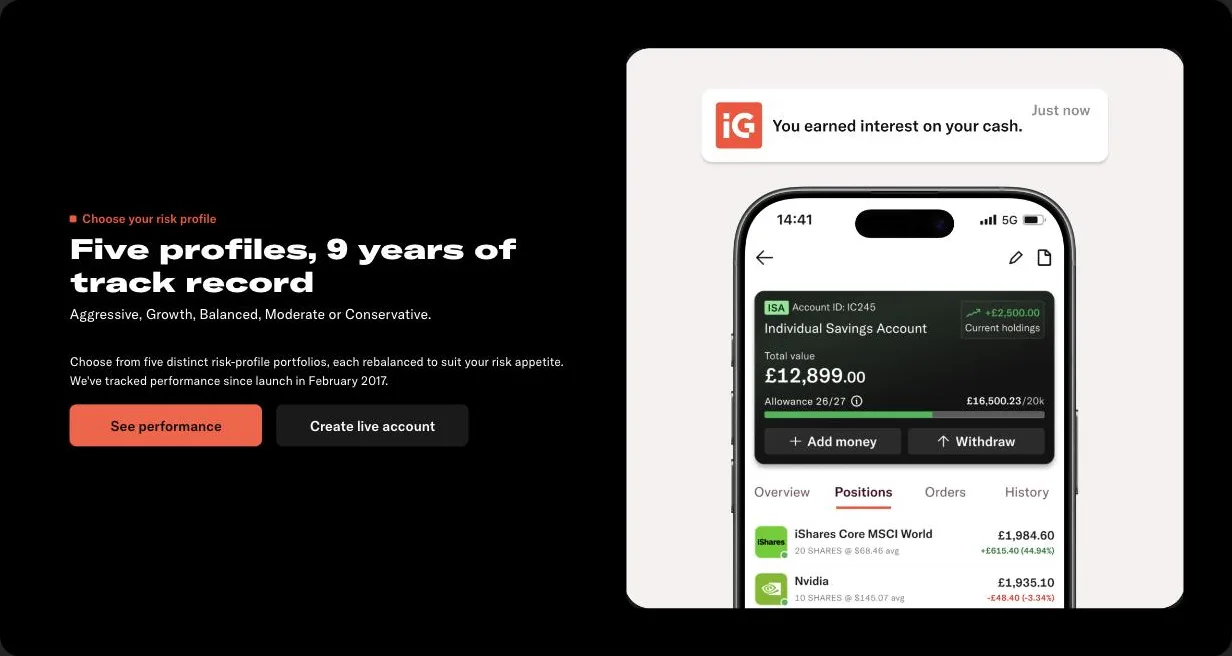
Smart Portfolios are IG’s managed service. You answer a few questions about your goals and attitude to risk, and IG matches you to one of five portfolios: Conservative, Moderate, Balanced, Growth or Aggressive. Each is built only from BlackRock’s iShares ETFs and spreads money across bonds, global shares and alternatives such as gold and property. IG manages and rebalances the portfolios using asset allocation insights from BlackRock. The service launched in February 2017.
The management fee is 0.50% a year on the first £50,000 in each account type and nothing on the amount above it, so it cannot exceed £250 a year per account type. It is calculated daily and taken monthly by selling a small amount of your ETFs. On top of that, the funds themselves cost about 0.13% a year (IG quotes a range of 0.11% to 0.14%), and IG estimates transaction costs at 0.09%. IG’s own example puts the total at 0.72%, or £288 a year, on a £40,000 portfolio.
There are no entry, exit, withdrawal or inactivity fees, and you can switch portfolio or withdraw at any time. Smart Portfolios are available in a GIA, an ISA and a SIPP; the SIPP version also carries the administrator’s £210 annual fee, which IG’s SIPP page confirms for Smart Portfolio SIPPs.
For comparison, InvestEngine charges 0.25% a year for its managed portfolios. Below £100,000 that is cheaper than IG’s fee; above it, IG’s £250 cap starts to work in its favour.
in a UK GBP GIA, ISA or SIPP, across UK, US, European and Australian markets.
on the GIA, ISA and Junior ISA, so a small or quiet account costs nothing to hold.
of 3.75% AER variable on sterling up to £100,000, paid daily, if you held or traded an investment in the previous 30 days.
with a GIA, a flexible Stocks and Shares ISA, a Junior ISA and a SIPP, plus Smart Portfolio versions of the GIA, ISA and SIPP.
with a 0.50% management fee on the first £50,000 and nothing above it, capped at £250 a year per account type.
on the London Stock Exchange, with 50 years’ experience by IG’s own account, and owner of Freetrade since 2025.
for electronic shares and ISAs, with IG aiming to complete incoming transfers within 14 days.
on more than 6,400 stocks, although only in the General Investment Account.
With dealing free, currency conversion is the main cost on US and European shares, and 0.7% is well above the 0.15% Trading 212 charges.
IG’s SIPP FAQs ask for £10,000 to open it, or a regular plan above £1,000 a month, and the administrator’s £210 yearly fee applies at least to Smart Portfolio SIPPs.
Mutual funds (OEICs) are not available, and there is no Cash ISA or Lifetime ISA.
IG’s new app replaces both its investing and its trading apps, so spread bets and CFDs sit in the same app as your ISA.
Capital at risk. Investments can fall as well as rise.
Capital at risk. Investments can fall as well as rise.
IG’s investing charges are short to list, and the important ones are about currency rather than commission. Every figure below was checked against IG’s own charges page and help articles on 5 November 2026. Rates change, so treat the date as part of the number.
One setting decides what you pay. By default your account uses instant FX conversion: dealing is commission-free and any currency conversion costs 0.7%. If you switch to manual currency conversion, you can hold US dollars, euros and other currencies without FX fees, but you lose commission-free dealing.
Dealing commissions
Currency conversion, the cost that matters
IG adds 0.7% to the exchange rate whenever a trade, deposit or withdrawal involves converting currency. On a £1,000 purchase of US shares that is £7 on the way in, and another 0.7% when you sell and convert back. A reduced 0.49% rate was guaranteed until 4 September 2026 and has now ended, although some of IG’s comparison tables still show it.
Account and holding costs
Deposits, withdrawals and transfers
Bank transfers, debit cards and credit cards are free for deposits and withdrawals, with a limit of £99,999 per debit card deposit and £30,000 per credit card deposit. Transfers of electronic shares and ISAs in and out of IG are free. Converting a paper share certificate costs £100 per certificate; IG’s pages differ on whether VAT is added on top.
Other charges
IG’s full investing charges are published on its costs and charges page, with more detail in its share dealing and ISA charges article. To see how other platforms compare on your own trading pattern, try our UK broker fees calculator.
IG offers support 24 hours a day through its app, WhatsApp and live chat, according to its share dealing page. For questions about opening an investing account there is a new accounts line on 0800 195 3100, open 8am to 6pm UK time on weekdays, and the helpdesk is on 0800 409 6789. A searchable help centre covers fees, ISAs, SIPPs and transfers.
Some SIPP matters, such as transfers in, contributions and taking benefits, are handled by the SIPP administrator rather than by IG.
Investing accounts are opened online or in the IG app. IG describes three steps: answer a few questions about yourself, get your identity verified, which it says usually happens straight away, then fund the account and start investing. You need to be a UK resident aged 18 or over.
The GIA is the starting point. You can add an ISA once it is open, and a SIPP or Smart Portfolio from the My IG dashboard. A Junior ISA can only be added by a parent or guardian who already has an IG account. The SIPP has an extra stage: the administrator sends an invitation to set up the pension plan, and IG activates the SIPP account once that is complete.
What to have ready: your National Insurance number if you are opening an ISA or SIPP, a bank account or card for funding, and, if you are transferring, the details of your current ISA or pension provider.
There is no minimum deposit for share dealing or the ISA. The SIPP is the exception, with its £10,000 or £1,000-a-month starting requirement.
You can fund the account by bank transfer, debit card, credit card or Apple Pay, with no deposit fees. Card deposits are limited to £99,999 per transaction for debit cards and £30,000 for credit cards, so larger amounts need splitting. Withdrawals are free unless they involve a currency conversion. After you sell shares the cash can be reinvested straight away, but it can only be withdrawn once the trade has settled, usually two business days later.
Keep in mind that YourWalletManager does not provide investment advice.
Individual investors should make their own informed decisions based on factual information.
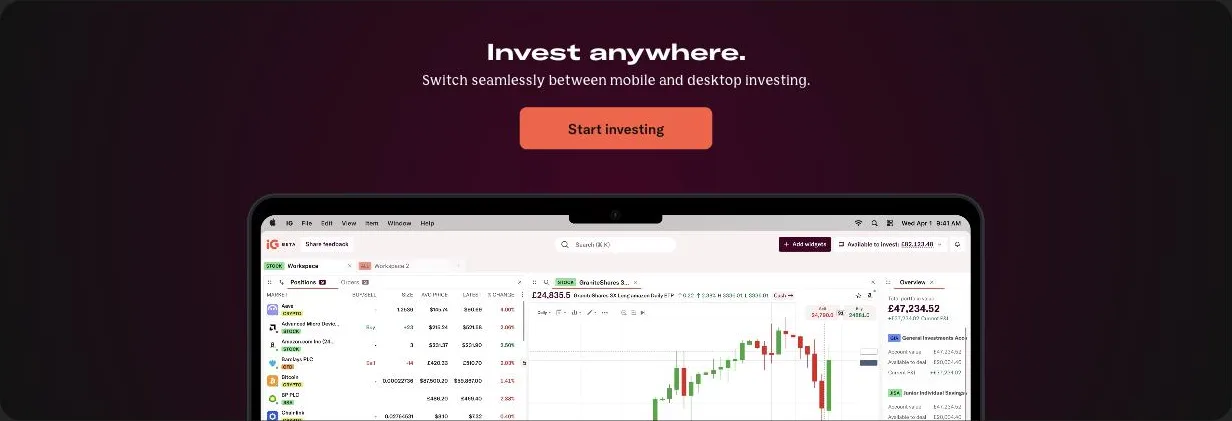
IG gives investors two ways into the same account: the IG app and a web-based share dealing platform. Positions show on both, so you can switch between them freely.
The app is the simpler route and suits most people buying shares and ETFs or checking a Smart Portfolio. The web platform adds more tools and analysis for experienced investors.
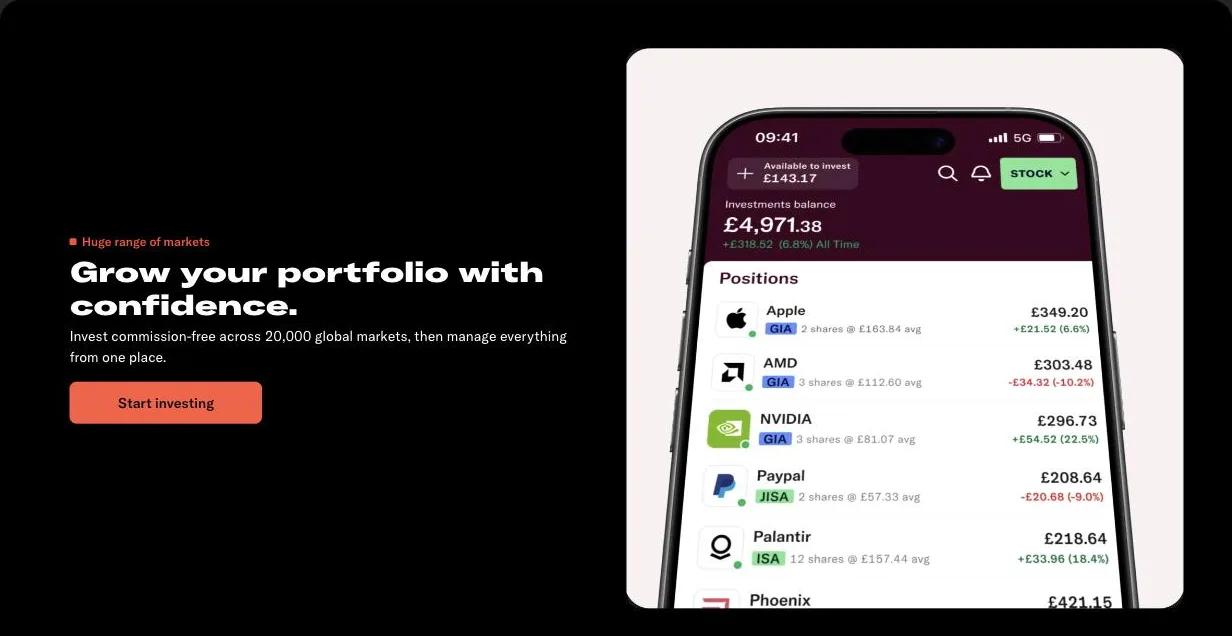
The new IG app is replacing both the IG Invest app and the IG Trading app. Existing customers are prompted to update, and IG says account details, funds and investment history carry across. It offers more than 20,000 stocks and ETFs across eight exchanges, the ISA, interest on cash, and a Focus Mode that lets you choose what appears on screen. IG notes that some features are being added shortly after launch.
The web platform, reached through My IG, is the place for more detailed research and account administration, and it is where you add a SIPP or Smart Portfolio. Live share prices are available by choosing a data feed in the settings.
L2 Dealer gives direct market access (DMA) to the order book for advanced investors and can be enabled on a share dealing account. Most people investing for the long term will not need it.
IG also offers extended-hours dealing on selected US shares outside the main US session, including 24-hour dealing on some stocks from Monday to Friday. The number of eligible stocks differs between IG’s own pages, and spreads can widen outside normal hours because fewer people are trading.
Dividends and shareholder rights. Dividends are credited to your account around their payment date, and you can hold the cash, withdraw it or reinvest it by buying more shares. IG sends a consolidated tax certificate summarising dividends and interest. Proxy voting at company meetings is free, while arranging AGM attendance or hard copy reports costs £100 plus VAT.
Fractional shares let you invest a set amount from £1 in more than 6,400 stocks, including large US companies whose single share price would otherwise be a barrier. They are only available in the General Investment Account, so they cannot be used inside the ISA or SIPP. Fractional trades do count towards the activity condition for interest on cash.
Transfers and Bed and ISA. Electronic shares and ISAs can be transferred to IG free of charge, and IG aims to complete transfers within 14 days, depending on your current provider. You may be out of the market while a transfer takes place. Paper share certificates can be converted for £100 each, which takes three to six weeks. Moving shares from the GIA into the ISA uses IG’s Bed and ISA service, which IG describes as paid-for; we could not find the fee on its published charges.
IG says investors can choose from more than 20,000 shares and ETFs across the UK, US, Europe and Australia. Some of IG’s own pages quote lower figures, between 11,000 and 13,000, so treat the exact number as approximate. Investment trusts are included.
For ETF investors, IG lists more than 3,000 UK-eligible ETFs from providers including iShares, Vanguard and Invesco, with a screener that can filter by ISA eligibility. If an ETF you want is missing, IG says you can ask its helpdesk to add it.
The gap is funds. IG states that mutual funds are not available, so OEICs and unit trusts, including many popular index funds, cannot be held. If funds are central to your plans, compare Hargreaves Lansdown or Vanguard.
IG’s investing accounts and Smart Portfolios are provided by IG Trading and Investments Ltd, authorised and regulated by the Financial Conduct Authority under register number 944492 and registered in England and Wales under company number 11628764, at 88 Wood Street, London EC2V 7QR. IG’s spread betting and CFD services are provided by different companies, IG Index Ltd and IG Markets Ltd, which are also FCA-regulated.
How your investments are held. Client shares are held in segregated nominee accounts with approved custodians, and IG has appointed Citi as sub-custodian. Shares may be pooled with other clients’ shares, but never with IG’s own. Client money sits in segregated trust accounts spread across banks including Barclays and Lloyds, and IG may place some of it in qualifying money market funds, as the FCA’s client money rules allow.
What the FSCS covers. If IG became insolvent, segregated money and assets would be returned to clients, less the administrator’s costs. Any shortfall may be covered by the Financial Services Compensation Scheme up to £85,000 per person. The FSCS does not cover falls in the value of your investments.
A separate limit applies only if one of the banks holding client money fails. In that case, eligible clients may claim up to £120,000 from the FSCS for the lost cash, subject to their other balances at that bank. IG’s own help pages are clear that the £120,000 limit does not apply if IG itself fails.
IG Group Holdings plc is listed on the London Stock Exchange and publishes its results, so its finances are open to scrutiny. IG says it has more than two million accounts worldwide. In April 2025 it completed the acquisition of Freetrade, adding another UK investing app to the group.
Client money and assets held by IG are subject to the FCA’s client asset rules, which require them to be kept separate from the firm’s own money and stop IG using them in its own business.
IG says it has 50 years’ experience in financial markets. That is a long operating record, but past resilience is not a forecast. Past performance is not a reliable indicator of future results.
IG is strongest for commission-free UK investing in an ISA that pays interest on cash. If you buy a lot of US shares, want funds, need a SIPP with a smaller starting balance, or prefer a different managed service, these are the alternatives we would look at first.
Best for lower FX costs
Trading 212
No commission on UK and US shares and ETFs, a 0.15% FX fee, and a flexible Stocks and Shares ISA, a Cash ISA and a SIPP with no account fee.
Capital at risk.
Best for global market access
Interactive Brokers
Currency conversion from 0.002% (minimum USD 2.00 per order), dealing from £3 per UK trade and 170 markets, plus an ISA and Junior ISA.
Capital at risk.

Best for low-cost ETF portfolios
InvestEngine
No platform fee on DIY ETF portfolios, plus ready-made managed portfolios if you would rather have help.
Capital at risk.

Best for funds and research
Hargreaves Lansdown
A wide range of funds, shares and bonds, plus in-depth research and phone support.
Capital at risk.
Best for low-cost index funds
Vanguard
Vanguard’s own LifeStrategy and target retirement funds in an ISA, SIPP or Junior ISA, from one of the world’s largest fund managers.
Capital at risk.
Best for an all-in-one app
XTB
Commission-free shares and ETFs within a monthly limit, a Stocks and Shares ISA and its own xStation platform.
Capital at risk. 74% of retail investor accounts lose money when trading CFDs with XTB.
Every platform here is authorised by the FCA. If you are still weighing them up, answer a few questions in our Find My Broker quiz.
IG’s investing accounts are provided by IG Trading and Investments Ltd, authorised and regulated by the FCA under register number 944492. Client money and shares are held separately from IG’s own, with Citi as sub-custodian for shares.
If IG became insolvent, eligible clients could claim up to £85,000 from the FSCS for any shortfall. The FSCS does not cover investment losses.
Online dealing in shares and ETFs is commission-free in a UK GBP GIA, ISA or SIPP, with no platform, custody or inactivity fee. The main cost is a 0.7% FX fee on any trade that involves converting currency, such as buying US shares. Phone dealing costs £40 for UK shares and £50 for US shares.
Yes. IG’s Stocks and Shares ISA is flexible, has no platform fee and gives commission-free access to the same shares and ETFs as the GIA. You can also hold a managed Smart Portfolio ISA and split your £20,000 allowance between the two. IG does not offer a Cash ISA or a Lifetime ISA.
IG’s SIPP page lists no annual SIPP fee for a self-managed SIPP and £210 a year for a Smart Portfolio SIPP, while its charges page and SIPP FAQs still quote £210 a year including VAT for every IG SIPP, so confirm before you open one. Dealing is commission-free, and a Smart Portfolio SIPP adds the 0.50% management fee, capped at £250 a year. IG’s SIPP FAQs say that to open the SIPP you need £10,000, as a transfer or single contribution, or a regular plan of more than £1,000 a month.
IG pays 3.75% AER variable on uninvested sterling up to £100,000 per client, across the GIA, ISA and SIPP. To qualify you must have held, bought or sold an investment in the previous 30 days. Non-sterling balances earn nothing. Interest on cash inside the ISA is tax-free.
Managed portfolios built from iShares ETFs, with five risk levels from Conservative to Aggressive. The management fee is 0.50% a year on the first £50,000 and nothing above that, capped at £250 a year per account type, plus fund costs of about 0.13% and transaction costs IG estimates at 0.09%.
There is no minimum deposit for share dealing or the ISA, and fractional shares in the GIA start from £1. The SIPP is the exception: it needs £10,000 to open, or a regular plan above £1,000 a month.
Yes, a stocks and shares Junior ISA with a £9,000 annual allowance, commission-free dealing and no account fee. A parent or guardian with an IG account opens it, and IG currently accepts applications only for children under 14.
Yes. Transfers of electronic shares and ISAs in and out of IG are free, and IG aims to complete them within 14 days, depending on your current provider, which may charge its own exit fee. Paper share certificates cost £100 each to convert.
The investing side is straightforward: IG pitches its app at people starting out, dealing is commission-free and there are ready-made Smart Portfolios. The main thing to watch is the 0.7% FX fee if you buy overseas shares. Beginners who mainly want US shares may find Trading 212 cheaper, and anyone who wants funds may prefer Hargreaves Lansdown.
For UK shares and ETFs, IG charges nothing to deal or to hold an account: no commission, no platform fee on the GIA, ISA or Junior ISA, and 3.75% AER variable on uninvested cash for as long as you hold an investment. Smart Portfolios add a managed option whose fee stops rising at £250 a year.
The weaknesses are specific. The 0.7% FX fee makes overseas shares more expensive than at several app-based rivals. The SIPP needs £10,000 to open, according to IG’s SIPP FAQs, and a Smart Portfolio SIPP carries a £210 annual administrator fee (IG’s pages disagree on whether a self-managed SIPP does). Funds, a Cash ISA and a Lifetime ISA are not available. And because IG’s new app combines investing and trading, spread bets and CFDs sit in the same app as your investments.
It suits investors who mainly buy UK-listed shares and ETFs, including the many global ETFs priced in sterling, anyone who wants a low-cost flexible ISA that pays interest on cash, and anyone looking for an inexpensive managed portfolio.
It does not suit frequent buyers of US shares, investors who want funds (OEICs), anyone who needs a Cash ISA, or someone starting a SIPP with less than £10,000.
YourWalletManager does not provide investment advice. Decide based on your own circumstances, and if you are unsure, take regulated advice.
This review follows the same process we apply to every broker, so you can see what the verdict above is actually based on.
When you invest, your capital is at risk and you may get back less than you put in. Past performance is not a reliable indicator of future results, and forecasts are not a reliable indicator of future performance.
Leveraged products. IG also offers spread betting and CFDs, which this review does not cover. Spread bets and CFDs are complex instruments and come with a high risk of losing money rapidly due to leverage. According to IG at the time of writing, 70% of retail investor accounts lose money when trading spread bets and CFDs with this provider. You should consider whether you understand how they work and whether you can afford to take the high risk of losing your money.
Protection. FSCS investment protection covers eligible claims up to £85,000 per person if IG Trading and Investments Ltd fails. It does not cover investment losses.
Tax and pensions. ISA and pension tax rules apply, tax treatment depends on your individual circumstances, and the rules may change. You can normally only access a SIPP from age 55, rising to 57 from April 2028.
YourWalletManager is not a financial adviser and does not provide investment advice. This review is general information only. If you are unsure whether a product is right for you, seek regulated financial advice.
Reviewed and updated on 5 November 2026 by the YourWalletManager editorial team. All fee, product and regulatory figures were checked against IG’s own UK website on that date. Rates and terms change, so check current figures before you act.
Bank Rate Rise 2026: What 4% Means For Savers And Investors
The Bank of England raised Bank Rate from 3.75% to 4% on 5 November 2026, the first increase since August 2023. Here is what the decision actually reaches…
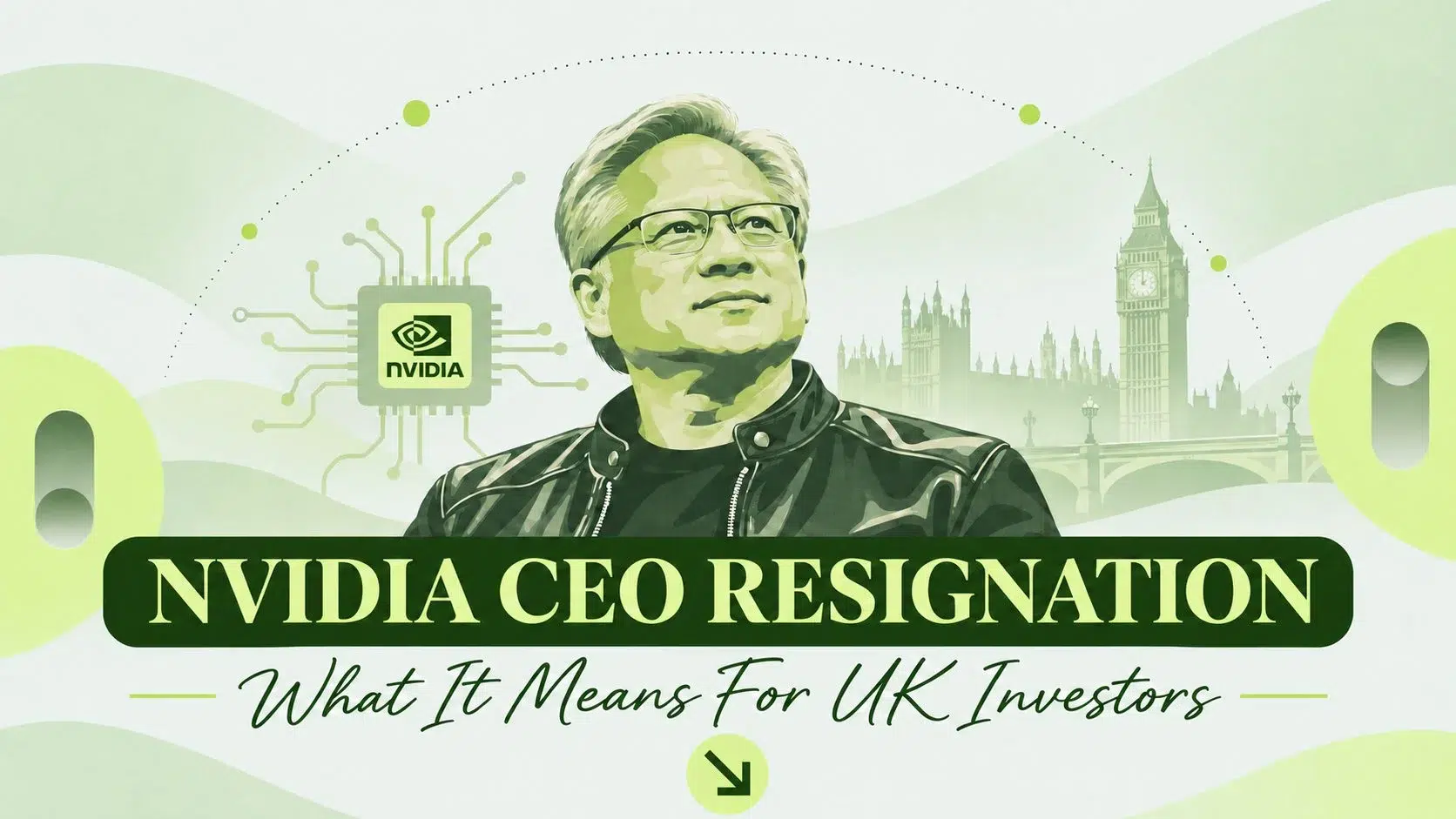
Nvidia CEO Shock Exit: How Does This Affect UK Investors?
Jensen Huang, who co-founded Nvidia in 1993 and ran it for 33 years, resigned as president and chief executive on Thursday 12 November 2026, with immediate effect. The…

Inherited Pension Tax 2027: What Changes For Your Family
The two year rule that could turn a tax free inherited pension into taxable income ended on 28 October 2026. From 6 April 2027, most unused pension funds…
About YWM
For general information only, not financial advice. Investing puts your capital at risk.
The information provided on this page and throughout the website is for general information purposes only and does not constitute financial advice. It is important that you conduct your own research and consider your own personal circumstances before making any investment decisions.
While we strive to provide accurate product information at the time of publication, the information may be subject to change by the provider at any time. Please always verify the product information before making any decisions. Past results do not guarantee future profits.
If you use some of the links on Your Wallet Manager, we may receive a small fee from our partners, supporting the website's free usage. However, please be assured that our editorial content is never influenced by these links. We include them to help us keep the lights on and to support our mission of helping people make informed financial decisions regarding their wallet’s most important spendings.
Thank you for your understanding and support!
Our top picks
All reviews
Reviews hubHead-to-head comparisons
Fees, account types and features side by side.
Welcome offers
Best providers
Free tools
Categories
Knowledge hubAdding {{itemName}} to cart
Added {{itemName}} to cart