























Nvidia CEO Shock Exit: How Does This Affect UK Investors?

Introduction
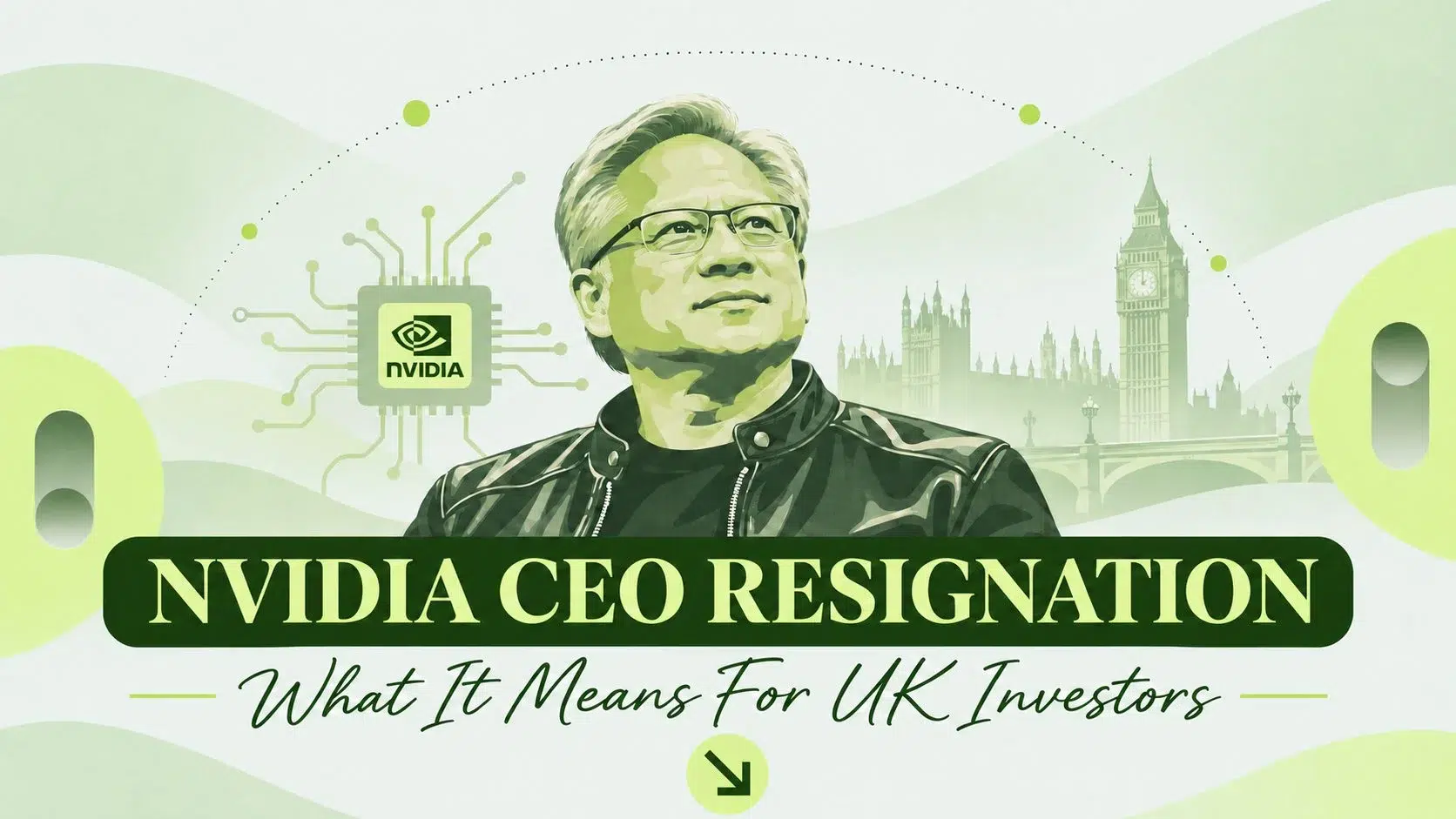
Jensen Huang, who co-founded Nvidia in 1993 and ran it for 33 years, resigned as president and chief executive on Thursday 12 November 2026, with immediate effect. The Nvidia CEO exit came at the end of a week of damaging headlines, and the shares fell close to 10% in early New York trading, taking the company’s value below $4 trillion.
For most UK investors this is not really a story about one share. Nvidia is the second largest company in the MSCI World Index, the benchmark behind many of the global tracker funds held in Stocks and Shares ISAs and SIPPs. If you own one of those funds, you already own a slice of Nvidia whether you chose it or not.
This article sets out what happened and when, who is running Nvidia now, what comes next, and how the news affects UK investors in pounds and pence.
This article is for information and education only. It is not financial advice or a personal recommendation. The value of investments can fall as well as rise and you may get back less than you invest. Tax treatment depends on your individual circumstances and may change in future. If you are unsure, seek advice from an FCA regulated adviser.
Quick Answer: What The Nvidia CEO Exit Means For You
Jensen Huang has stepped down and Chief Financial Officer Colette Kress is the interim Nvidia CEO while the board searches for a permanent successor. Nvidia made up 5.25% of the MSCI World Index at the end of October, so a 10% fall in its shares takes roughly £52 off a £10,000 global tracker. That is about half of one per cent.
What Happened, And When
The resignation did not come out of nowhere. It followed four days in which questions about Huang’s personal conduct moved from a board inquiry to a change of leadership.
| Date | What happened |
|---|---|
| Sunday 8 November | Nvidia’s board opened an independent investigation, overseen by independent directors with outside counsel, after reports that Huang had been the target of a foreign intelligence effort. The board said it had no reason to believe national security or company secrets were compromised. Huang also publicly admitted an extramarital affair and apologised. |
| Monday 9 November | Nvidia shares fell 5.7% as investors weighed the possible fallout. |
| Wednesday 11 November | The New York Times reported a second relationship, with a senior Nvidia executive who reported to Huang. The shares closed at $173.73. |
| Thursday 12 November | Huang resigned as president, chief executive and board member, effective immediately. The shares fell close to 10% in early trading. |
Sources: NVIDIA board statement, 8 November 2026; NVIDIA Form 8-K, 12 November 2026; CNBC and PA Media reporting. Verified 12 November 2026.
Nvidia’s own announcement gives no reason for the departure. It thanks Huang for his contributions and says the board expects operations, customer commitments and the product roadmap to continue without interruption.
Who Replaces The Nvidia CEO For Now
Colette Kress, Nvidia’s chief financial officer since September 2013, is interim chief executive. She keeps her finance role at the same time, and before Nvidia she spent nearly 25 years in finance at Cisco and Microsoft. The board has started looking for a permanent Nvidia CEO and says it will consider both internal and external candidates.
The board has also appointed its first ever chair, Harvey C. Jones, a technology executive and venture investor who previously ran chip design software company Synopsys as chief executive and executive chairman. Separating the chair from day-to-day management is a standard governance safeguard, and it gives shareholders a named person overseeing the search.
Results Are Still On The Calendar
Nvidia confirmed it will report third quarter results for fiscal 2027 on Tuesday 17 November, as previously scheduled, with an earnings call shortly afterwards.
Why The Share Price Fell So Hard
Huang was not simply a manager. He steered Nvidia’s move from gaming graphics into the chips that power artificial intelligence, and he was the public face of that strategy to customers and shareholders alike. Losing a founder in a single morning, with no successor ready, is what investors call key person risk: the danger that a business depends too heavily on one individual.
The market had already been pricing some of this in. Nvidia’s shares had fallen more than 20% over the previous month, and they dropped 5.7% on Monday 9 November alone after the board investigation was announced. Before the resignation, several analysts told CNBC that a departure could knock 20% off the stock.
It is worth separating two things. The fall reflects uncertainty about leadership and strategy, not a change in how many chips Nvidia sold this quarter. And unlike some technology companies, Nvidia has no dual-class share structure giving its founder voting control, which is one reason the board was able to act quickly.
How Does This Affect UK Investors?
The honest answer is that it depends almost entirely on what you hold. Here are the three most common situations.
A global tracker. The MSCI World Index holds 1,248 companies across 23 developed markets. At 30 October 2026 Nvidia was its second largest holding at 5.25%, just behind Apple at 5.65%, and the United States made up 72.77% of the index against 3.52% for the United Kingdom, according to the MSCI World factsheet. As we explained in our guide to the Fed rate hike, a global fund is mostly a US fund in practice.
An S&P 500 tracker. Nvidia is the largest company in the US index, at roughly 8% of its value through September and October 2026. A US tracker therefore feels the move more than a global one.
A FTSE 100 tracker. Nvidia is not in the index at all, and London’s blue chip market carries far less technology than New York, as our look at FTSE 100 oil exposure shows. Any effect here is indirect, through general market mood.
Source: MSCI World Index factsheet, 30 October 2026 (Nvidia 5.25%). S&P 500 weight approximate at about 8%, from index and fund holdings data for September and October 2026. Nvidia is not a FTSE 100 constituent. Illustration only, ignores currency moves. Verified 12 November 2026.
In short, on a £10,000 holding a 10% fall in Nvidia’s shares costs nothing in a FTSE 100 tracker, about £52 in a global tracker and about £80 in an S&P 500 tracker. If you hold Nvidia shares directly, or a technology fund concentrated in chipmakers, you feel much more of the move.
The Currency Effect Behind The Headline
Nvidia is priced in US dollars, but your ISA or SIPP is valued in pounds. In an unhedged global or US fund, the sterling value you see depends on both the share price and the exchange rate on the day. A weaker dollar can deepen a fall in pounds, and a stronger dollar can soften it.
Your fund’s factsheet will say whether it is currency hedged. Most low cost global trackers are not, so it is worth knowing which kind you own before reading too much into a single day’s number.
What Happens Next At Nvidia
Three things now set the pace, and none of them has a fixed outcome.
| What to watch | What we know so far |
|---|---|
| Third quarter results | Due Tuesday 17 November 2026 after the US market closes, at about 9.20pm UK time, with an earnings call to follow. These are the first figures under interim leadership. |
| Permanent CEO search | Internal and external candidates will be considered. No timetable has been published. |
| Board investigation | Run by independent directors with outside counsel. No timeline or findings have been published. |
Sources: NVIDIA Form 8-K and press release, 12 November 2026; NVIDIA board statement, 8 November 2026. Verified 12 November 2026.
Results days often bring large price moves for Nvidia in either direction. This time investors will be listening as much for what customers and the interim team say about continuity as for the figures themselves.
Compare UK investment platforms side by side, on fees and features.
Capital at risk.
What To Ignore
Confident predictions of where Nvidia’s share price will be by Christmas, in either direction. Nobody yet knows who the next chief executive will be, so nobody can price that choice.
Be wary, too, of headlines treating one resignation as proof that the whole AI boom is over. A move of around half a per cent in a diversified fund is the kind of fluctuation long-term investing is built to absorb. If you want a reminder of what staying invested does over decades, try our compound interest calculator.
Key Takeaways
Huang Resigned On 12 November 2026
He left as president, chief executive and director with immediate effect. Colette Kress is interim CEO and keeps her CFO role, and Harvey C. Jones is the board's first chair.
Global Trackers Hold About 5% In Nvidia
Nvidia was 5.25% of the MSCI World Index at 30 October 2026, so a 10% fall costs a £10,000 global tracker roughly £52.
FTSE 100 Trackers Have No Direct Exposure
Nvidia is not a FTSE 100 constituent, so UK index funds are affected only indirectly, through wider market sentiment.
Results Land On 17 November
Nvidia reports after the US close that evening, the first set of results under interim leadership.
Not sure which platform fits the way you actually invest?
Capital at risk.
Frequently Asked Questions About The Nvidia CEO Resignation
Who is Nvidia's CEO now?
Colette Kress, previously chief financial officer, is interim chief executive while the board searches for a permanent Nvidia CEO. She continues as CFO in the meantime.
Is Nvidia in my FTSE 100 or FTSE 250 fund?
No. Nvidia is listed in the United States and is not a constituent of either UK index. You hold it only through a global, US or technology focused fund, or by owning the shares directly.
Should I sell my global tracker because of this?
We cannot tell you what to do with your money, and this article is not advice. What we can say is that Nvidia was around 5% of the MSCI World Index at the end of October, so the rest of a global tracker is spread across more than a thousand other companies.
Does this change anything about my ISA or SIPP itself?
No. The tax rules, allowances and protections of the wrapper are unaffected. Only the value of the investments held inside it moves with the market.
Sources
Sources: NVIDIA Form 8-K, CEO transition announcement, 12 November 2026; Statement from NVIDIA Board of Directors, 8 November 2026; MSCI World Index factsheet, 30 October 2026; CNBC, 12 November 2026; PA Media via LBC, 9 November 2026; Reuters via The Standard, 9 November 2026; 24/7 Wall St, S&P 500 holdings data, 7 October 2026. Verified 12 November 2026.
This article is for information and education only. It is not financial advice or a personal recommendation. The value of investments can fall as well as rise and you may get back less than you invest. Tax treatment depends on your individual circumstances and may change in future. If you are unsure, seek advice from an FCA regulated adviser.